Bitcoin Sees 40 Percent Gain Against Gold Since March 2026
 to****@gmail.com2026-05-07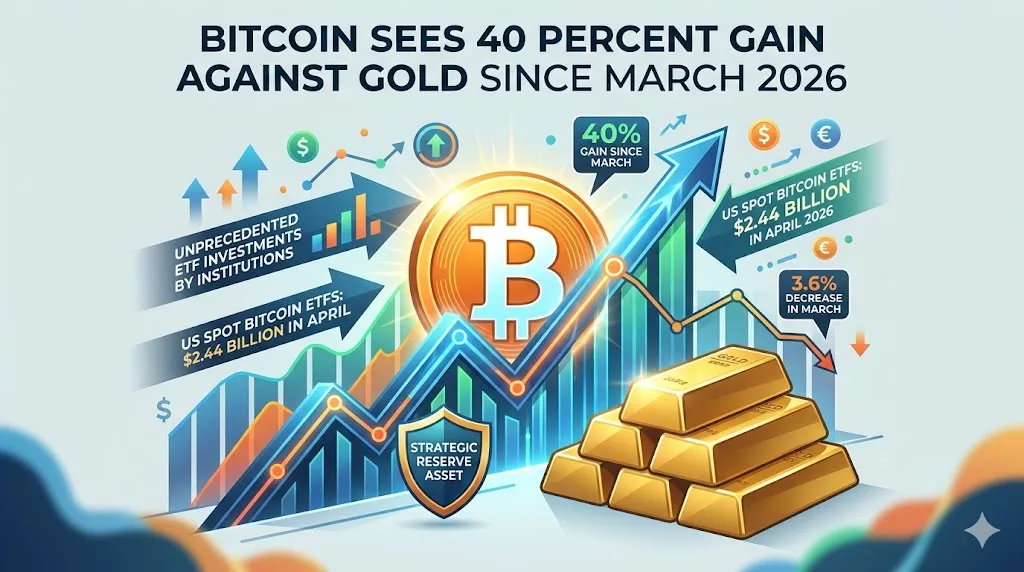
Significant Performance Disparity: Bitcoin beat gold by 40 percent from March 1 through April 30, 2026, on the back of unprecedented ETF investments by institutions.
There has been tremendous growth of Bitcoin in the past two months, where it has risen by 40% in comparison to gold in early 2026.
Key Takeaways
- Significant Performance Disparity: Bitcoin beat gold by 40 percent from March 1 through April 30, 2026, on the back of unprecedented ETF investments by institutions.
- Dominance of ETF Investments: US Spot Bitcoin ETFs experienced an unbelievable $2.44 billion in net inflows for April 2026 alone, twice the level observed in March.
- Conservative Nature of Gold: As Bitcoin was soaring, gold recorded a price decrease of 3.6 percent in March 2026 owing to the strengthening of the US dollar.
- A Strategic Reserve Asset: Financial organizations have decided to categorize Bitcoin as a strategic reserve asset instead of being a trade.
Introduction
Perhaps you have been wondering whether or not your savings are serving you well enough in this new economic climate. Many people have counted on gold as the best form of security for years, but the happenings of the last sixty days have turned all conventional wisdom upside down. Beginning from March 2026, there has been a remarkable separation between gold and bitcoin, during which the cryptocurrency soared to new heights and left the oldest store of wealth trailing way behind.
It is no surprise if you find yourself bewildered by the pace at which the financial markets are evolving. You may be tempted to ask whether you are too late to join the bandwagon or if there is more to come. Whatever the case, this guide provides answers to questions like why did the 40 percent increase occur, what do big players in the market do with their funds, and how can you keep up with them?
Why Bitcoin Left Gold Behind
The arrival of spring 2026 has been one of both confidence in traditional money and the emergence of scarce digital assets. After struggling to keep up with higher interest rates, gold has seen its values decline significantly, while Bitcoin has enjoyed unprecedented adoption by the professional institutional community reaching its apogee in April 2026, with many institutions beginning to add large quantities of Bitcoin to their portfolios.
On April 30, 2026, the US spot Bitcoin ETF market recorded strong performances for the month and year to date. Amongst the top performers among the Bitcoin ETFs during the month was BlackRock’s iShares Bitcoin Trust (IBIT), which alone captured over 70% of the total institutional inflows in April. By the end of the month, the IBIT and its institutional investors held over 810,000 BTC, totalling approximately $62 billion.
Gold's Recent Roadblocks
On the other hand, gold traders may have assumed that the recent geopolitical tensions would result in increases in the value of gold; however, gold experienced a significant price correction in March 2026. According to World Bank data, the value of precious metals fell by approximately 3.6% during March. With rising interest rates and a strong US dollar, gold has become much more boring and therefore less appealing to traders looking for high-growth hedges against inflation.
Step 1: Follow the Bitcoin to Gold Ratio To see this increase in value, the Bitcoin to gold ratio is one that needs to be reviewed. At the end of April 2026, the Bitcoin to Gold ratio was 16.54, which means that 16.54 ounces of gold are now equal to 1 bitcoin. Monitoring this metric can help you determine which of these two assets is "winning" the battle to be the preferred store of value by comparing them on a consistent basis over a number of days.
Step 2: Watch ETF Volume Look at daily inflow numbers on platforms such as Binance or Coinbase. When daily inflows for multiple days consecutively exceed $100 million, this usually indicates that large banks and hedge funds are accumulating bitcoin, and building a price floor.
Step 3: Look for Macro Trends Bitcoin has started to respond to the same "risk-on" signals as technology equities. When the Federal Reserve indicates that it may stop raising interest rates, bitcoin often has a much larger upward response than gold because of its higher velocity characteristics.
Fun Fact: Cumulative lifetime inflows into US bitcoin ETFs officially passed $58.5 billion in April 2026, and surpassed $102 billion in total assets under management.
Preventive Measures: How to Protect Your Gains
In such volatile markets, your biggest concern shouldn't be the potential loss in price; it should be the loss of access to your funds due to poor security practices or emotional decisions.
- Utilize Cold Storage: Never keep all of your funds in one place. Even with the added security of 2026, the principle "not your keys, not your coins" still applies.
- Establish Trailing Stop Orders: If you have gains of 40%, set a trailing stop loss at 10%. This way, you can ride out the wave until the market makes a swift change.
- Ensure Platform Solvency: Utilize only exchanges that offer Proof of Reserves in real time. Transparency will be the currency of 2026.
Special Cases and Alternative Scenarios
You must understand the many types of market freezes. A market freeze may happen for a variety of reasons, and if your money is "locked," it may be because of the way it is being stored or due to an issue with the platform you use to store it.
Different Types of Market Freezes Wallet Block vs. Exchange Freeze. If your funds are in cold storage on your own hardware and have been "blocked" due to an issue with the software that is used to access your hardware, then you can typically rectify this by using another wallet provider with the same seed phrase(s).
If your funds are held by an exchange like Bybit or Kraken and your account has been frozen, it is likely due to "Know Your Customer" (KYC) requirements pertaining to the 2026 GENIUS Act, which requires you to complete KYC processes described in the act. In order to regain access to your accounts at these exchanges, you must update your KYC documentation, as specified above, immediately.
Risks and Benefits of the Digital Gold Shift
All financial decisions have two facets, so you'll want to be aware of all the trade-offs before moving any of your capital.
Benefits One major benefit of Bitcoin's current surge is how liquid and easily transportable it is. For example, moving 100 million dollars worth of gold would take time, be costly and would likely require you to rent a vehicle or hiring someone else, but you could send 100 million dollars worth of Bitcoin anywhere in the world for very little due to extremely low transaction fees, all in a matter of minutes. The fact that Bitcoin has increased by 40% against the price of gold demonstrates that Bitcoin has established itself as the new go-to "inflation hedge" for tech-savvy younger investors.
Risks The volatility of Bitcoin represents one of the largest risks associated with investing in this asset. For instance, a decrease or increase of 2% in a week's time is not out of the ordinary for gold, whereas a movement of 10 % in just an hour is possible with Bitcoin. If your threshold for experiencing stress or panic is minimal, it is easy to envision how the "adrenaline rush" of trading in crypto would lead to making hasty decisions at precisely the wrong times. Furthermore, regulatory changes are always perceived as a "wild card" which could affect your investment immediately, with little or no notice.
Conclusion
The information from March and April of this year has shown us clearly that the bridge has been built connecting traditional finance with digital assets. With Bitcoin returning 40% more than gold on an investment in just two months, the case for holding at least a small amount of digital currency in your investment portfolio has never been more compelling. We have also entered into an era of financial infrastructure, moving well beyond the speculative stage.
You need to assess your investment allocation to determine whether you still are holding investment money that isn't keeping up with inflation. There is no need to sell everything and purchase Bitcoin today, but you should consider using a balanced approach. Look for opportunities to invest in either using a regulated ETF or a secured private digital wallet. The gap between digital gold and physical gold continues to widen, so making an informed choice will greatly impact where your investments will reside at the end of 2026 year.
What steps will you take to transition your portfolio to accommodate this new era of digital currency dominance?