Bitcoin Adoption Is Rising, But Price Action Is Telling a Different Story

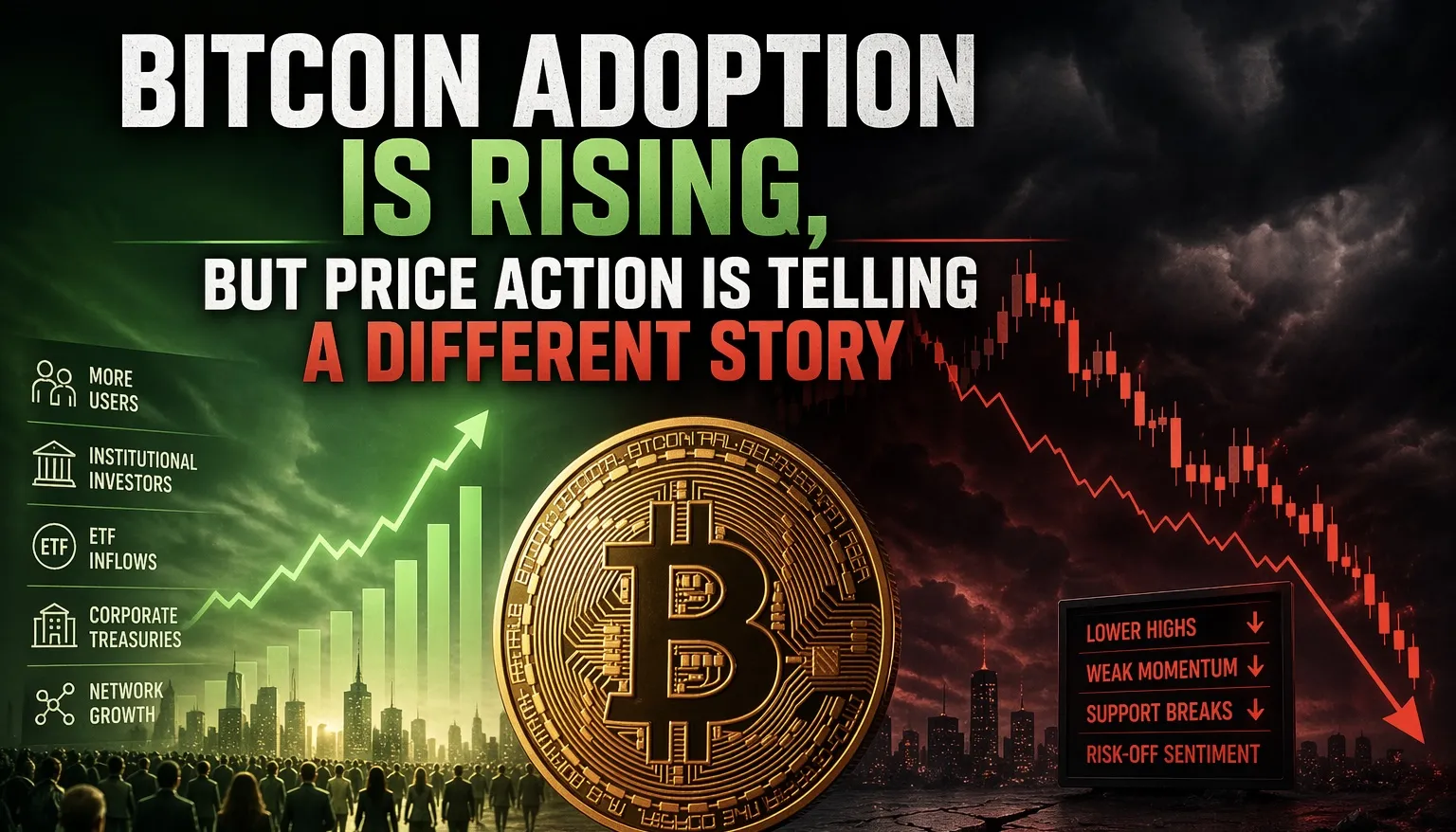
Bitcoin is maturing into an institutional asset. While adoption grows via infrastructure and ETFs, price lags due to macro pressures, passive buying, and reduced retail volatility.
Right now, I see a divergence in the market. On one hand, institutions, banks and corporations are adopting Bitcoin faster and faster. On the other side, price action seems lagging, flopping and sometimes disconnected from that acceleration narrative.
This is leading to an important question among traders and analysts: if it really is gaining momentum, and scale is really building, then why is this not being reflected by price?
The reason is because Bitcoin is developing from a retail investment loaded with speculation towards becoming a more complex institutional financial product.
Adoption Is No Longer a Narrative, It’s Infrastructure
Where we are today is that it is not retail investors buy and hodl anymore. It is more about structural integration into traditional finance.
Major financial institutions are increasing their risk through regulated products, custody and indirect investment vehicles. Banks are focussing their efforts on developing infrastructure to support digital assets services. Corporates continue to perceive Bitcoin as a treasury or strategic reserve asset.
Payments and settlements systems are also starting to expose itself indirectly to Bitcoin in addition through various ETF, derivatives, tokenized financial products..
This implies that Bitcoin is no longer on the outside of the financial system, but instead is starting to become part of it.
Why Price Isn’t Moving the Same Way
While this is the trend, price action has been muted. Bitcoin has begun to rollover rather than display explosive upside, with the dominant move at least for now being the cyclical rally and correction, behaving more reflexively to macro dynamics than adoption headlines.
Some structural reasons account for this gap.
Institutional adoption is another big factor which lags and overwhelms the retail speculation. Institutions accumulate, they often do so passively and do not chase momentum.
This also signifies that although the demand is rising, it is being taken in than rising suddenly.
Macro Conditions Are Still Dominating Short Term Moves
Bitcoin‘s short term price trend continues to reflect the prevailing macroeconomic factors of rate expectations, liquidity, and geopolitics.
Even during capital inflows, risk assets tend to react initially to liquidity rather than structural influences. During periods of liquidity restriction or increased uncertainty, capital flight can be defensive and dampen upside momentum.
This results in a dueling effect of upward versus downward pressure: long term structural demand, against the short term macro pressure.
Market Structure Is Changing Behind the Scenes
The second element within the wider disjoint which needs highlighting is the change in market structure. Bitcoin is no longer confined to offshore retail brokers but appears in various layers of the financial infrastructure.
This introduces new dynamics:
Price discovery is more dispersed
Liquidity is more substantial yet heterogeneous
Large flows can be hedged/neutralized
Calms down a bit compared to previous cycles
Put simply, the more mature Bitcoin becomes, the less violent the “Price Action” is likely to be.
Adoption vs Price Divergence
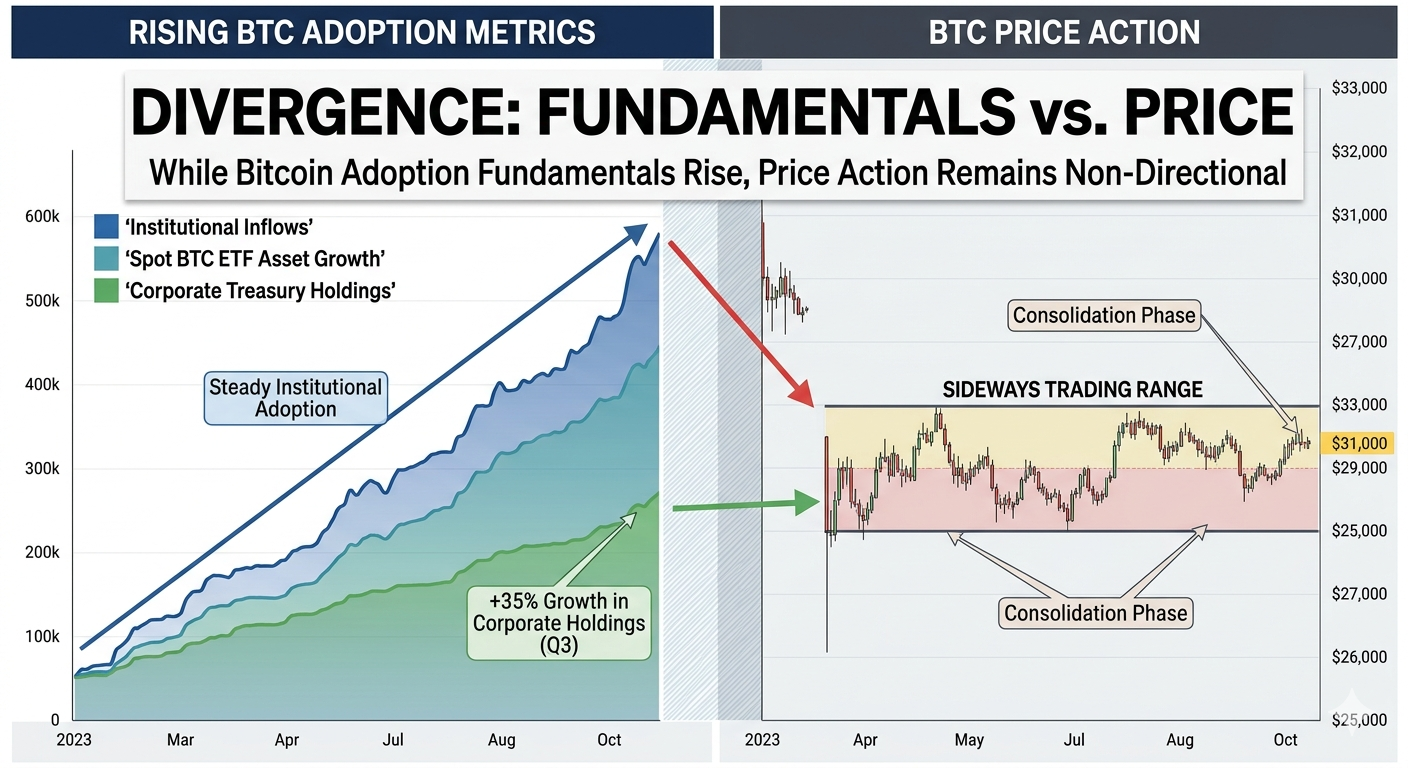
Fundamentals vs. Price: While institutional adoption and ETF growth trend upward, Bitcoin's price continues to trade sideways, highlighting a significant divergence between network growth and market value.
Institutions Don’t Trade Like Retail
The most significant structural dissimilarity is the behavior of institutions in comparison to retail traders.
Retail investors react efficiently on stories momentum and sentiment. Institutions react on long term positioning, risk management and regulation.
This means institutional inflows often:
Enter gradually over months or quarters
Avoid chasing price spikes.
Use hedging strategies which cancel the effect of spot purchase
Concentrate on exposure, not guesswork
Therefore, increasing penetration may not necessarily provide short term pricing pressure.
Supply Distribution Is Also Evolving
Another unseen variable is supply distribution. When more of Bitcoin is held by long term institutions and custodians, circulating supply acts differently.
More coins are being held in:
Long Term Custody
Within ETF shapes
Corporate treasuries,
Illiquid wallets
This lowers supply, but also decreases take-up of contracts, which can deaden short term frictions to price change.
The Lag Between Adoption and Price
Historically, Bitcoin has experienced a time lag between driven demand and price increase. Infrastructure is initially created, however market participants then slowly realize the extent of the demand and revalue the system.
In previous cycles, similar patterns emerged where:
- Major rallies came after infrastructure increased; However the data for the maximum number of people in each rally shows the need for infrastructure expansion to be preceded by the mass mobilization of people.
- Institutional entry results in periods of slow accumulation
- The price jumped when liquidity tightened or catalysts aligned.
- This indicates that the apparent divergence is not an anomaly but an attribute of the development of the market over time.
What Could Close the Gap
There are several reason why price may be less in line with adoption.
May be a catalyst such as an acceleration in liquidity expansion, appetite for risk restoring or macro easing. Whereas, alsoa continued institutional accumulation but avoiding of selling pressure may slowly curtail the supply environment.
When the forces do line up, then price action will start to directly mirror the overall trend in adoption.
Conclusion
This disparity does not imply any contradiction between adoption and price action. On the contrary, it indicates a market evolving.
On one side, adoption is speeding up all across institutions, corporations, and financial infrastructure. On the other side, price is being defined by macro environment, institutional behavior and market structure.
In other words, adoption is laying the groundwork, but the price is still responding to the now.
As the asset evolves into a fully integrated financial asset, the fundamentals to price gap will at some point close. However we are not yet there; the implications that such a spot entails for the market has still to be fully grasped.