Apple Pulls Bitchat from China App Store

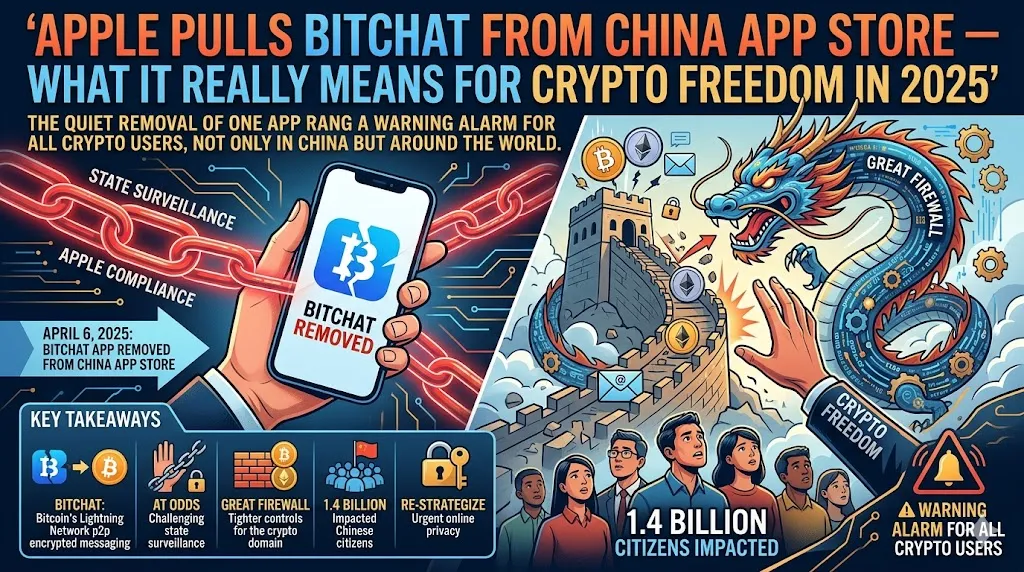
On April 6, 2026, Apple removed the Bitchat app from the China App Store
The quiet removal of one app rang a warning alarm for all crypto users, not only in China but around the world.
Key Takeaways
- On April 6, 2026, Apple removed the Bitchat app from the China App Store
- Bitchat runs on Bitcoin's Lightning Network for peer-to-peer encrypted messages, putting it at odds with state surveillance activities
- This move marks another step towards tighter controls for the "Great Firewall" in the crypto domain
- More than 1.4 billion Chinese citizens are impacted by this latest development
- Crypto users need to re-strategize their online privacy efforts right now
Introduction
All of a sudden, millions of Chinese users woke up and went to the App Store only to find it empty! Bitchat - the encrypted messaging app powered by Bitcoin - had become an essential service for those who cared about their privacy and just vanished from users' access!
Without any notice or reason, Bitchat left China without anyone having a clue as to where it had gone.
If you have been following China's relationship with cryptocurrency, this isn't the most shocking thing you have ever heard. However, the real concern here is that this isn't a problem that is only occurring in China anymore. What happens in China doesn't always stay in China. Other countries watch what is going on with each other. Policies get copied. And today's "regional restriction" typically leads to a worldwide discussion.
In this guide, we break down the events surrounding the disappearance of Bitchat and how you can protect your access to cryptocurrency tools immediately.
What Is Bitchat — And Why Did China Want It Gone?
Bitchat is an application that works differently than the rest of the messaging applications that you may use. To allow for their encrypted messaging functionality, Bitchat utilizes the Lightning Network built on top of Bitcoin, which allows users to send messages to each other without having to rely on a central server. This means there is no middle man in these transactions, nor is there a company (e.g., Apple) storing users' messages, so that there is no method/ability for a government once again, to go to a company (or third party) and request their records. This presents a huge problem for China.
For decades China has built a highly sophisticated digital censorship system (the Great Firewall) that is able to prevent a large majority of Western digital platforms from being accessible from within the Mainland of China. With this being said, Bitchat represents something unlike anything else that was ever created by a non-Westerner; a "crypto-native" communication layer that is almost nearly impossible for China to monitor or shut down from the inside out.
Because of this, China went after the "front door" (Apple) instead of attacking the application directly. In fact, according to reports, Apple has "removed over 2.5 million Chinese Apps from the App Store" since 2017, at least 70% of which have been deemed Unsafe and therefore were removed to keep the Apple ecosystem and China being unsafe). Apple has made it no secret that they have complied with the requests of the company previously mentioned (the government) so that they can continue to operate in the country of China (one of their largest revenue streams).
The 3-Step Pattern China Keeps Using to Tighten Crypto Control
This move was not an outlier. The country follows a well-known pattern. Once you learn it, you will never forget.
Step One: Disrupt the Infrastructure
They start by going after exchanges and financial entry points. In 2017, China banned crypto exchanges. By 2021, the country had made all cryptocurrency transactions illegal. It shut down access to funds.
Step Two: Silence the Communication
Then, they silence the dialogue. Bitchat helps crypto communities collaborate, communicate, and connect. Shutting it down eliminates a critical form of dialogue for crypto communities within China.
Step Three: Exert Pressure on the Gatekeepers
Last, they use corporations such as Apple, Google, and Huawei to enforce their policies. They don't need to announce any measures. They simply need to send an email. The application vanishes the next day.
This strategy is a new iteration of the Great Firewall. It doesn't focus on blocking websites anymore. Instead, it involves deleting applications before anyone realizes what is happening.
What This Means for Crypto Users Right Now
Preventive Measures: Protect Your Access Before the Window Closes
This doesn’t mean you must be physically present in China for the effects to hit home. Here’s what savvy cryptocurrency users are doing today:
- Download applications from the developers' official sites rather than depending only on app stores.
- Employ physical devices such as Ledger and Trezor wallets so that your funds remain under your control.
- Engage with decentralized communities on platforms such as Nostr, which cannot be de-platformed.
- Keep updated by paying attention to the blockchain data and GitHub accounts of the developers.
Conclusion
The instance of Bitchat's removal demonstrates that there are truly larger implications than one would expect. Many have thought about how important 2026 will be in regards to crypto censorship; however, 2026 will go far beyond just being a major year for money alone. The upcoming year is going to determine how we communicate, have access too, and maintain our freedoms!
The good thing is that there are already many ways to combat against these types of actions. The real question will be if people will do anything to stop them from occurring (before they actually happen).
Make sure to get started on auditing your own crypto tools, diversifying your various access points to those tools, and never taking for granted your favorite apps will still exist the following morning!