How Geopolitical Events Shape the Crypto Market
 yo****@gmail.com2026-04-18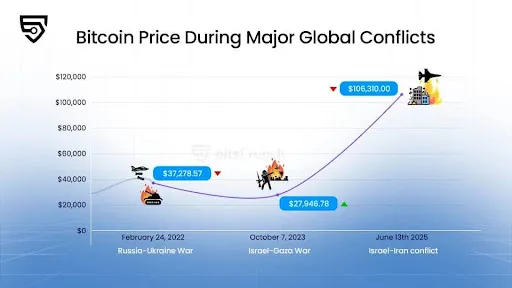
Geopolitics From Ukraine's crypto donations to Iran's Bitcoin oil tolls, geopolitical events move crypto faster than any other force. Here's what the data shows.
Most people think of crypto as a technology story. Charts, protocols, token launches. But when you look closely at the price history of Bitcoin against a timeline of world events and something else emerges entirely. Wars, sanctions, ceasefires, banking crises, elections, all of them leave fingerprints on the market. Understanding how and why is not just interesting. For anyone trading or holding digital assets, it becomes a necessity.
The Market That Never Closes
Before getting into specific events, one crypto fact must be stated: crypto markets run 24 hours a day, seven days a week. There are no closing bells or circuit breakers. When a geopolitical shock hits on a Sunday night or in the middle of a foreign country's afternoon, traditional stock markets are locked shut. Crypto is not. This makes it the first visible signal of how the world is feeling about risk at any given moment, and it also means it absorbs shocks that other markets can delay processing until Monday morning.
This is the starting point for understanding everything that follows.
Russia, Ukraine, and the First Real Test
On February 24, 2022, Russia launched a full-scale invasion of Ukraine. Within days, something unprecedented happened. The Ukrainian government posted its official Bitcoin, Ethereum, and USDT wallet addresses on Twitter and asked the world to send money. In the first month alone, Ukraine received over $56 million in crypto donations. A single donation from Polkadot co-founder Gavin Wood was worth $5.8 million. Vitalik Buterin donated at least $5 million. UkraineDAO auctioned an NFT of the Ukrainian flag for $6.5 million in Ethereum, making it one of the most expensive NFTs ever sold at the time.
This was not charity through traditional channels. Wire transfers would have taken days and faced bureaucratic delays. Crypto moved in minutes, across borders, without a bank's permission. Ukraine's deputy minister of digital transformation later confirmed the government was using donated Bitcoin to purchase supplies in Europe, with crypto community members converting it to euros to buy food, fuel, and military equipment in real time.
Meanwhile, on the other side of the conflict, Russian citizens faced a collapsing ruble and sudden disconnection from Visa, Mastercard, Apple Pay, and the SWIFT messaging system. Trading volumes of Bitcoin and stablecoins in Russia spiked as ordinary people scrambled to protect savings from a currency in freefall. Stablecoin transfer volume related to the conflict increased by hundreds of percent in the weeks following the invasion.
What did Bitcoin's price do? It surged 20% in the days following the invasion as speculation grew that Russian capital would flee into crypto. But that initial jump gave way to a brutal reality. The war pushed European energy prices to historic highs, forced the US Federal Reserve into the most aggressive rate hiking cycle in four decades, and by the end of 2022, Bitcoin had crashed over 65% from its peak. The short-term narrative of crypto as a safe haven collided with the long-term reality of a macro environment turned hostile.
The Gaza Conflict: A Different Lesson
When war broke out between Israel and Hamas in October 2023, the market's reaction was notably different. Bitcoin briefly fell below $27,000 as traders sold risk assets. But within weeks it was climbing again, eventually reaching $66,000 by May 2024. A key data point from this period: USDT transfer volume increased by 440% week-on-week in the early days of the conflict. People in the region were not reaching for Bitcoin as an investment.
They were reaching for stablecoins as functional money, a tool for survival in areas where traditional banking had become unreliable or inaccessible.
This distinction matters. The Gaza conflict illustrated something researchers have documented repeatedly: in developing countries and war zones, geopolitical instability drives up Bitcoin and stablecoin volumes not because people see opportunity, but because they need an alternative to a broken system.
Iran and the Strait of Hormuz: 2026
The most recent and perhaps most dramatic example arrived this month. The US-Iran war sent Bitcoin below $68,000 as markets priced in extended conflict and energy supply disruption. Then, on April 7 2026, President Trump announced a two-week ceasefire contingent on Iran reopening the Strait of Hormuz. Bitcoin jumped to $72,738 in hours, nearly $600 million in leveraged short positions were liquidated, and global stock futures rallied. When reports emerged days later that ceasefire terms were being violated, Bitcoin pulled back toward $71,000.
One analyst described the situation in terms that would have seemed impossible five years ago: in April 2026, Bitcoin's primary price driver is not the Federal Reserve, not ETF inflows, and not the halving cycle. It is Iran. The ceasefire calendar is moving the price more directly than any on-chain metric.
Even more striking: reports emerged that Iran had been charging oil tankers passing through the Strait of Hormuz approximately one dollar per barrel in Bitcoin. A sanctioned nation, locked out of the global financial system, using the world's largest cryptocurrency as a toll collection mechanism for one of the most critical energy chokepoints on earth.
What the Data Shows
Academic research covering Bitcoin from 2015 through 2024 reveals a more nuanced picture than the popular narratives suggest. During periods of lower Bitcoin prices, heightened geopolitical risk actually reduces volatility rather than increasing it. Investors pull back, trading activity drops, and the market goes quiet. During bull markets, geopolitical shocks cause an initial spike in volatility followed by stabilisation.
Research comparing Bitcoin, Ethereum, BNB, Cardano, and Dogecoin during the Russia-Ukraine war found that Bitcoin and Ethereum showed partial hedging properties under moderate geopolitical stress, while altcoins like BNB, ADA, and Dogecoin showed much higher vulnerability. Among stablecoins, USDC behaved as a safe haven. Tether, interestingly, consistently lost value during peak uncertainty, reflecting liquidity concerns rather than the stable peg narrative.
Perhaps the most sobering finding: less than 5% of safe-haven funds released during geopolitical conflicts ultimately flow into crypto. Gold remains the primary flight-to-safety trade. When Operation Epic Fury began in February 2026 and Bitcoin dropped from $68,000 to $63,000, gold surged over $100 per ounce in a single session to hit $5,393. The comparison tells its own story.
The Identity Problem
What makes crypto's relationship with geopolitics so difficult to predict is a fundamental identity conflict the asset class has not yet resolved. Is Bitcoin digital gold, a censorship-resistant store of value that rises when trust in governments fails? Or is it a high-beta technology asset that falls alongside the Nasdaq when institutions need to de-risk?
The evidence says: both, depending on the context. During the 2018 US-China trade war, Bitcoin occasionally spiked when tensions escalated, suggesting some investors treated it as a hedge. During the Liberation Day tariffs of April 2025, it dropped 10% alongside tech stocks, behaving exactly like a speculative risk asset. In 2022 it served as humanitarian infrastructure for a nation at war, while simultaneously collapsing due to the same war's macroeconomic consequences.
Bitcoin's correlation with the Nasdaq has intensified in recent years, meaning that for institutional investors who entered through ETFs, it increasingly trades like a high-growth technology position rather than a monetary alternative. But in the developing world, in sanctioned economies, in countries experiencing currency crises, it continues to function as something else entirely: a parallel financial system that governments cannot shut down.
What This Means for You
Geopolitical events move crypto markets in ways that are faster, sharper, and less predictable than most traditional assets. The framework for reading them is not complicated, but it requires nuance.
Conflict onset almost always triggers an initial sell-off as institutions liquidate liquid assets to move into cash or gold. Recovery speed depends on the scale and duration of the conflict. Localized wars tend to see faster crypto rebounds. Trade wars and sanctions regimes, which affect the entire global economic architecture, tend to produce deeper and more sustained drawdowns.
Stablecoin demand spikes during every crisis, regardless of what Bitcoin does. This is the clearest and most consistent signal in the data.
Peace announcements, ceasefires, and diplomatic breakthroughs produce some of the sharpest short-term rallies in the market because leveraged short sellers get squeezed simultaneously.
And underneath all the price action, the infrastructure quietly does what it was built to do: move value across borders, without permission, regardless of who is at war with whom.