John Oliver Takes Aim at Prediction Markets and Crypto Betting Culture
 Natalia Ivanov2026-04-23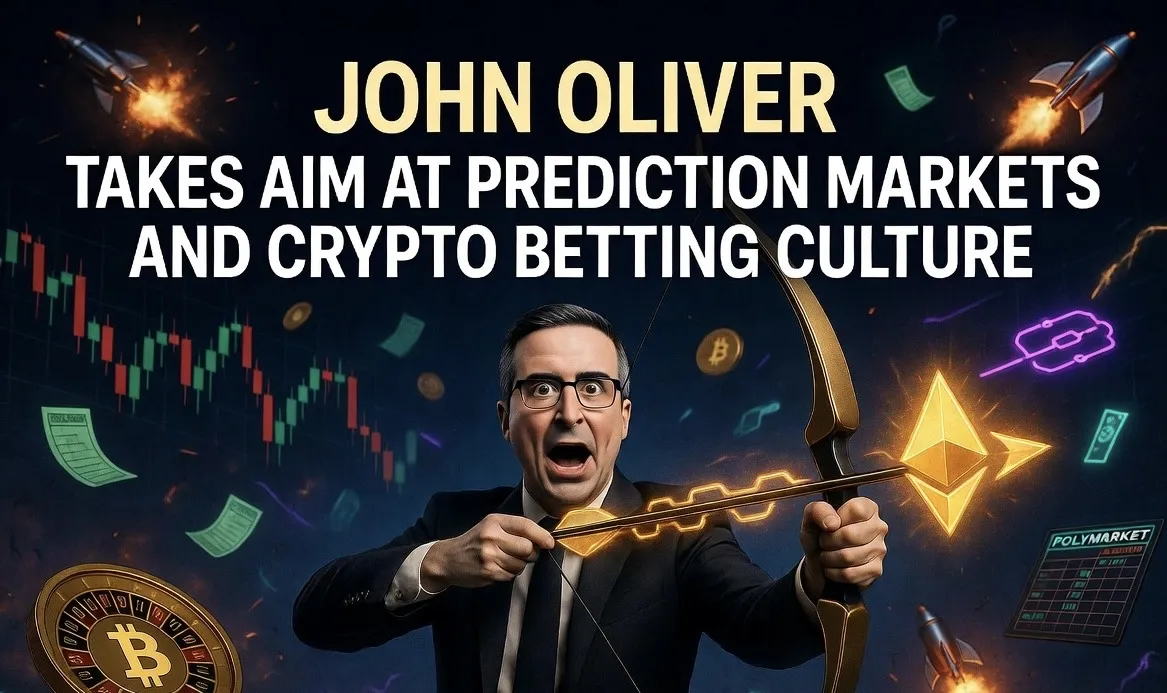
John Oliver critiques prediction markets like Kalshi, citing risks of manipulation, thin regulation, and the blurring line between collective intelligence and gambling.
The television personality John Oliver has recently become interested in the very quickly expanding area of prediction markets. On an episode of Last Week Tonight with John Oliver, he discusses how prediction markets work and whether they are regulated sufficiently.
Oliver looks at how users are able to bet on various outcomes when using different prediction markets, such as Kalshi and Polymarket, including some absurd bets about people using certain words during speeches; he argues that this is a ridiculous way for people to use these types of bets but also suggests that lawmakers do not do enough oversight to protect the betting public.
The Blurring Line Between Information and Gambling
Oliver's critique focused on how prediction markets are no longer fulfilling their initial function of aggregating public opinion, which could be used to predict future events based on collective intelligence. Nowadays, there are numerous types of prediction contracts that provide little or no valuable information; therefore, the distinction between being an informational market and a form of entertainment-driven gambling has become less clear.
According to Oliver's presentation included in the section on political speech, he described how betting contracts that allowed users to wager on various statements made by employees of Donald Trump's administration and how this form of gambling raises questions as to if those platforms provide valuable information or just turn political discourse into a game.
Not only is this a philosophical issue; this is also an example of how financial compensation can cause whether or not an individual behaves or expresses themselves within certain limits will become a part of the outcome of their behavior or expressions as opposed to only being a predictor of their behavior or expressions.
Donald Trump Jr.’s Involvement Raises Eyebrows
One more area that was focused upon within this segment was Donald Trump Junior's involvement. Reports indicate that he has had a dual role as an advisor to both Kalshi and Polymarket. John talked about whether or not there could be conflicts of interest between political figures and their associates that could arise because of his dual advisory relationship with these betting platforms and other political event betting channels.
There is a lot of sensitivity between this relationship and broader political influences that affect prediction markets. Predictions markets are viewed as potentially less fair and more corrupt when someone is connected to political or governmental power AND is seen as a bettor on a prediction market’s website.
Regulatory Concerns and the Role of the CFTC
There have been questions about the agency's responsibility in policing event contracts. This includes event contracts that deal with sensitive items (i.e., items that should not be regulated). Mr. Michael Selig has given most of this criticism to the organization; he believes that since he has been chairman, the committee has come under tremendous scrutiny and criticism for not aggressively pursuing event contracts relating to controversial issues (i.e., terrorism, murder, and war).
There has been significant ethical discussion around the existence of these types of contracts, with some critics arguing that creating a betting mechanism on violent or destabilizing events will create a normalized and/or incentivized method to commit such behaviours. In contrast, others assert that prediction markets just illustrate the public's expectation of what may occur without causing an event to happen.
Oliver's commentary was generally skeptical of the regulatory approach as being too passive given the fact that there are potentially serious risks associated with prediction markets.
Market Manipulation and the Brian Armstrong Example
During the third-quarter 2025 earnings call for Coinbase, the CEO Brian Armstrong is said to have stated several crypto-related keywords that happened to be active bets on prediction markets.
As Oliver explained, it allowed those who placed wagers that those words would be spoken by a prominent person to collect their winnings because they were eventually used by someone who was well known. This demonstrates the ease with which events in certain markets can be manipulated, particularly when the criteria for the bet are defined very narrowly.
This example highlights a larger weakness in prediction markets. The more that solution outcomes are based on discrete, controlled actions rather than real-world events that are unpredictable & complex, the more potential there is for manipulation.
The Question of Integrity in Prediction Markets
Central to Oliver's critique is his concern about the integrity of these platforms. Although prediction markets operate on the premise that all parties involved are operating autonomously with no single actor being able to alter the outcome of the market, Oliver argues that as soon as:
• The outcome is connected to an individual's decision versus a large event/group of events
• The influential party has knowledge of the live bet(s)
• An economic incentive exists to sway the outcome of a particular live bet
Then prediction and participation become less distinct, therefore also calling into question the reliability of these markets as predictive instruments.
Media Partnerships and Ethical Tensions
The discussion about news organizations pairing with predictive services introduces more depth and complexity to this discussion. Most often described as creative approaches that allow publication providers to engage with their subscribers, issues surrounding innovation have arisen on the question of whether or not there is a problem with these types of cooperations and relationships.
In expanding your platform to include news-related predictive betting as part of your service, the question arises as to whether or not these media organisations have any editorial independence from the betting platforms. If so, even the most innocent comments made between representatives from one group and representatives from the other could lead to concerns regarding bias.
Oliver then went on to explain that the level of integration between predictive markets and the overall information ecosystem is accelerating rapidly.
A Growing Industry Under Scrutiny
Despite ongoing criticism, prediction markets are continuing to gain traction with users, driven primarily by the combination of new developments in blockchain technology and growing uses of alternative financial instruments. Examples of this movement are seen through companies such as Kalshi and Polymarket, which have positioned themselves as being at the intersection of finance, technology, and entertainment.
As the clips clearly show, there is a real demand for something beyond what is already being offered and, as can be seen through some of the more skeptical segments, this new growth is also coming with some new questions for regulators, policymakers, and the public.
Conclusion
John Oliver‘s comprehensive treatment of prediction markets provides a useful critique on an asset class that is currently just emerging into the mainstream. The subsections he provides on trivial markets, game tricks, political and government interests and regulation emphasize the difficulties that this fledgling industry faces.
The regulatory character of a market will become more and more crucial as these markets become more developed. As the market develops, and platforms like Kalshi and Polymarket become more innovative, and their popularity increases, then the CFTC or another regulator may take shape. This brings us to the always relevant question: once the market becomes so big is there a spot for a regulator to enter and create a domain of peril, or should they just let the market develop itself?