How LBank Copy Trading Dominates the 2026 Passive Income Meta: Complete Beginner's Guide


Learn how LBank copy trading works in 2026, how to pick low-drawdown traders, manage risk, and build a diversified system for consistent crypto returns without full-time trading.
Manual trading in 2026 feels like bringing a slingshot to a drone strike. Markets now move at algorithmic speed, with AI-driven strategies and institutional liquidity shaping price action in milliseconds. For most retail traders, keeping up consistently is difficult—especially in volatile crypto markets.
That shift explains why passive strategies have gained traction. In particular, copy trading has evolved from a niche feature into a structured system for accessing experienced execution without trading full-time.
In regions like Asia-Pacific, which now account for a significant share of global crypto activity, demand for automated and semi-passive trading tools continues to rise. Platforms like LBank have expanded their copy trading infrastructure to meet that demand.
This guide breaks down how LBank copy trading works in 2026, how to evaluate lead traders, and how to build a risk-aware system designed for consistency rather than hype.
Why Copy Trading Crushed Buy-and-Hold in 2026
For years, “buy and hold” dominated crypto strategy discussions. But today’s market behaves differently. Rapid sector rotations, leverage-driven volatility, and liquidity sweeps mean that static positioning often underperforms active execution.
Copy trading addresses this gap by allowing users to automatically mirror the trades of experienced traders in real time. Instead of monitoring charts constantly, users allocate capital to traders whose strategies align with their risk tolerance.
On LBank, this system has expanded beyond simple mirroring. Lead traders operate across futures, perpetual contracts, and spot markets, with performance data openly displayed for evaluation.
LBank Copy Trading 2026: Key Features You Need to Know
Before diving into strategy, grasp the toolkit. LBank's Futures Copy Trading (FCT) shines here, updated for 2026 with isolation and smarts.
Sub-Account Magic for Risk Isolation
Ditch the all-in-one wallet nightmare. FCT sub-accounts ring-fence your copy funds. Lead trader bombs a position? Your spot holdings sleep safe. No accidental liquidations from overleveraged futures. Set up's a breeze: Fund via main account, toggle sub-account mode, pick your ratio. Pro tip: Start small, like $500, to test the waters.
Smart Ratio vs. Fixed Amount: Scale Like a Boss
Fixed Amount? That's rookie hour. You dump flat $100 per trade, blind to the pro's conviction. Smart Ratio flips the script. It mirrors their position size as a percentage of your balance.
Example: Trader risks 5% on an ETH long. System deploys 5% of yours. High-conviction 20% bet? You scale accordingly, minus your custom cap. This dynamic sizing beats fixed every time for compounded growth.
In short, LBank flipped copy trading into a 2026 powerhouse. Global volumes hit new highs, with Asia-Pacific traders leading charges on BTC perps and altcoin swings.
Feature | Fixed Amount | Smart Ratio |
|---|---|---|
Position Sizing | Static ($ per trade) | % of balance |
Risk Adaptation | None | Mirrors trader conviction |
Best For | Tiny tests | Long-term scaling |
2026 Edge | Basic | Dominant for volatiles |
Fixed allocation applies the same dollar amount to every trade. While simple, it ignores the trader’s conviction level. Smart Ratio, on the other hand, adjusts your position size proportionally. If a lead trader risks 5% of their capital, your system mirrors that percentage. This creates a more adaptive and scalable approach to compounding.
Loss Protection and Risk Controls
LBank occasionally provides promotional loss-protection vouchers for new users, which may offset initial losses. However, these are temporary tools—not long-term risk solutions.
More important are built-in controls such as:
- Per-trade stop-loss settings
- Maximum drawdown limits
- Allocation caps per trader
These tools help reduce exposure, but they do not eliminate risk. Copy trading amplifies both gains and losses, particularly in leveraged markets.
How to Choose the Right Lead Traders
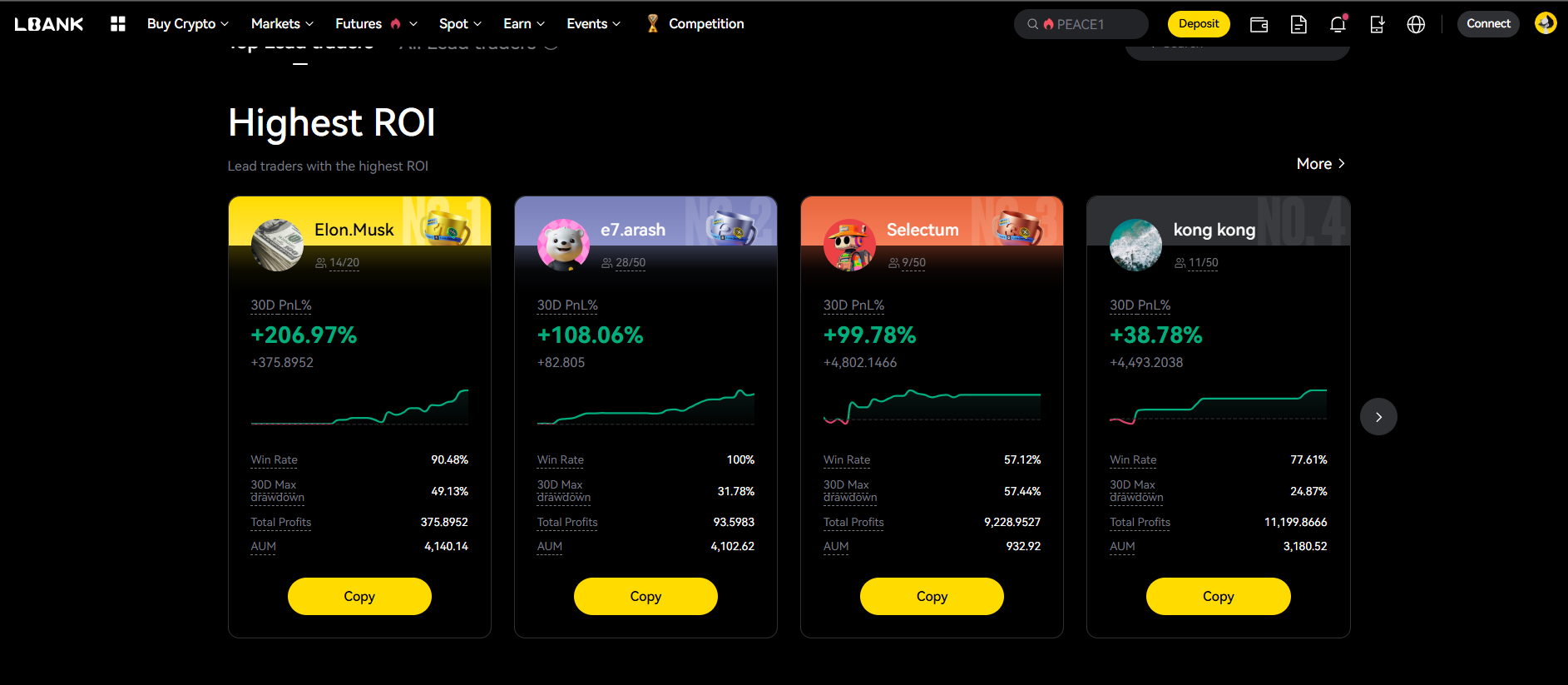
Performance alone can be misleading. A trader showing high returns may also be taking excessive risk.
A more reliable approach is to evaluate consistency and downside control.
1. Maximum Drawdown (MDD)
Maximum Drawdown measures the largest peak-to-trough decline in a trader’s equity.
- Conservative benchmark: under 25%
- Aggressive strategies: up to 40%
- Above 50%: high risk
This is one of the most important metrics for long-term sustainability.
2. Assets Under Management (AUM)
Higher AUM often indicates trust from other users. While not a guarantee of quality, it can signal that a strategy has been tested across different conditions.
3. Profit Factor
Profit Factor (gross profit divided by gross loss) gives a clearer picture than win rate alone.
- Above 1.5 → generally sustainable
- Below 1.2 → weaker edge
4. Recent Performance and Activity
Look at:
- 30-day performance
- Trade frequency
- Consistency of execution
Avoid traders with very limited recent activity, as their results may not reflect current market conditions.
Metric | Green Flag | Red Flag | Why It Matters |
|---|---|---|---|
MDD | <25% | >50% | Survives black swans |
AUM | >$500K | <$50K | Crowd validation |
Profit Factor | >1.5 | <1.2 | Sustainable edges |
Win Rate (30d) | >65% | <50% | Recent momentum |
Total Equity | >$100K | <$10K | Aligned risks |
Bonus: Cross-check Elite Trading Championship alums. $300K prize winners often top 2026 boards.
Step-by-Step: Setting Up LBank Copy Trading in 2026
Ready to roll? Follow this LBank copy trading tutorial. Assumes verified account.
- Secure Your Account: Hit that 2FA guide first. Watch this step-by-step video for lockdown.
- Fund Sub-Account: Deposit USDT, transfer to FCT sub (min $100).
- Plaza Hunt: Filter "Futures," MDD <25%, AUM >$500K, Smart Ratio.
- Invest: Toggle Smart Ratio (2-10% cap), set global stop-loss 15%.
- Claim Vouchers: Bonus Center > New User > Loss Protection.
- Monitor: Dashboard tracks PnL sync, manual overrides if needed.
Takes 10 minutes. First profits hit the same day on active leads.
Advanced 2026 Strategy: Diversify to Dominate
Set-it-forget-it loses. Treat copy trading like portfolio management. Allocate smart across styles.
- 40% Conservative Anchor: Low MDD (<15%), swing focus. Steady 2-3% monthly.
- 40% Mid-Tier Scalper: 25-35% MDD, high frequency. Catches intra-day pops.
- 20% High-Octane Contender: Championship beasts, 40%+ MDD. Home runs for alts/perps.
Rebalance quarterly. Use LBank's data export for Excel tweaks.
Risk math: Cap single trader at 25% allocation. Global drawdown target <20%.
Real talk: This mix yielded 150%+ in Q1 2026 simulations on LBank recaps, outpacing solo HODL.
LBank Copy Trading vs. Competitors: 2026 Breakdown
Why LBank over Bybit or Binance? Sub-account isolation, smart scaling, and championship-fueled talent pool.
Platform | Smart Ratio | Loss Vouchers | MDD Filters | AUM Transparency | 2026 Volume Rank |
|---|---|---|---|---|---|
LBank | Yes | Yes | Granular | Full | Top 20 |
Bybit | Partial | No | Basic | Medium | Top 10 |
Binance | No | Limited | Basic | High | #1 |
Phemex | No | No | None | Low | Mid-tier |
LBank wins on newbie-friendliness and futures depth.
Common LBank Copy Trading Mistakes to Avoid in 2026
- Chasing leaderboard flash: PnL without MDD kills.
- Fixed Amount only: Misses scaling alpha.
- No diversification: One bad lead tanks all.
- Ignoring fees: 10% profit share standard, but volume tiers save.
- Skipping stops: Vouchers help, but auto-exits save more.
Fix these, and you're lightyears ahead of many traders.
LBank Copy Trading FAQs (2026 Edition)
Is LBank Copy Trading Legit for Passive Income?
Yes, but “passive” doesn’t mean risk-free.
LBank has built a structured copy trading system with verified lead traders, real-time trade mirroring, and increasing participation volumes in 2026. This infrastructure makes it technically reliable.
However, returns depend entirely on:
- The quality of traders you follow
- Your risk allocation strategy
- Market conditions
A realistic expectation is 1–5% monthly returns with disciplined diversification and proper risk control. Higher returns are possible, but they usually come with significantly higher drawdowns.
What Is the Minimum for LBank Futures Copy Trading?
The minimum allocation starts at $100 per sub-account. That said, smaller balances limit flexibility. Most experienced users find that:
- $100–$300 → limited diversification
- $500+ → optimal for Smart Ratio allocation and better risk distribution
At higher capital levels, you can split funds across multiple traders, reducing dependency on a single strategy.
How Much Do Lead Traders Charge?
Lead traders typically take a 10–20% profit share.
Key things to understand:
- Fees are only charged on profitable trades
- No profit = no fee
- Losses are not reimbursed by the trader
This aligns incentives, but it also means you carry full downside risk.
Can I Copy Multiple Traders on LBank?
Yes, and you should. LBank allows users to copy multiple traders simultaneously, which is critical for risk management.
A smarter approach is to:
- Allocate across 3–5 traders
- Mix different styles (scalping, swing, trend-following)
- Avoid overexposure to a single market bias
Diversification is what separates sustainable returns from account blowups.
What Happens If a Trade Loses? Does LBank Offer Refunds?
Losses are part of the system — and they are your responsibility.
There is no standard refund mechanism for ongoing losses. However:
- Promotional vouchers may occasionally offset initial losses
- Risk controls like stop-loss settings are essential
In practice, your protection comes from:
- Choosing disciplined traders
- Setting maximum drawdown limits
- Avoiding over-leveraged strategies
Build Your Passive Empire Today
Crypto moves fast, but speed without structure is how accounts disappear. LBank copy trading gives you access to experienced execution, but your edge comes from how you build around it. Filter for consistency, not hype. Look for low drawdown, stable win rates, and disciplined risk profiles. Use Smart Ratio to control exposure, diversify like a portfolio manager, and let compounding do its quiet work over time. This isn’t about chasing explosive gains; it’s about stacking controlled, repeatable returns.
The real shift happens when you treat copy trading like a system, not a shortcut. Head to the LBank Copy Trading Plaza, sort by 30-day performance, study maximum drawdown, and allocate capital with intent. Start small, observe behavior, and scale only when consistency proves itself. Your first setup won’t be perfect—but refining it is where the edge is built.
What’s your biggest concern with copy trading
Picking the wrong trader
Hidden risk / drawdown
Fees eating profits
Not enough control