LBank vs Bybit Copy Trading (2026): Which Platform Is Better for Passive Income?

Compare LBank and Bybit copy trading in 2026. Explore features, risk controls, fees, and usability to choose the best platform for steady crypto income.
Copy trading has changed the game for retail traders in 2026. Manual trading demands constant screen time and quick decisions. Most people cannot keep up with institutional algorithms or AI bots. Platforms like LBank and Bybit offer a middle ground. You select experienced lead traders and let their trades mirror in your account. This setup provides semi-passive exposure to crypto markets without building strategies from scratch.
Copy trading allows you to mirror the positions of experienced traders in real time. Instead of watching charts all day, you allocate capital and let the system execute trades on your behalf. It sounds simple, but results depend heavily on how the system is set up and which traders you follow.
Two platforms that stand out in this space are LBank and Bybit. Both offer copy trading features, but their approach to risk control, allocation, and user experience differs in important ways.
This guide compares LBank and Bybit copy trading in 2026 across features, fees, transparency, and usability so you can decide which platform fits your strategy.
How Copy Trading Works in 2026
Copy trading links your funds to a lead trader's positions. When they buy or sell Bitcoin futures, your account follows at a set ratio or amount. Lead traders earn a share of profits from followers. You control the allocation size and can stop at any time.
Key elements include allocation method, how trades scale, and risk exposure. Platforms verify lead traders using metrics such as past performance and assets under management. Copy trading reduces emotional decisions. It still carries full market risk. Losses happen if the lead trader underperforms. Diversification across multiple traders helps manage this. In 2026, systems handle high-leverage perpetuals and spot trades. Expect real-time execution with minimal slippage on liquid pairs.
Copy trading is not risk-free. If the trader loses money, you lose money. The goal is not to eliminate risk but to manage it through diversification and proper allocation.
Platform Overview
LBank
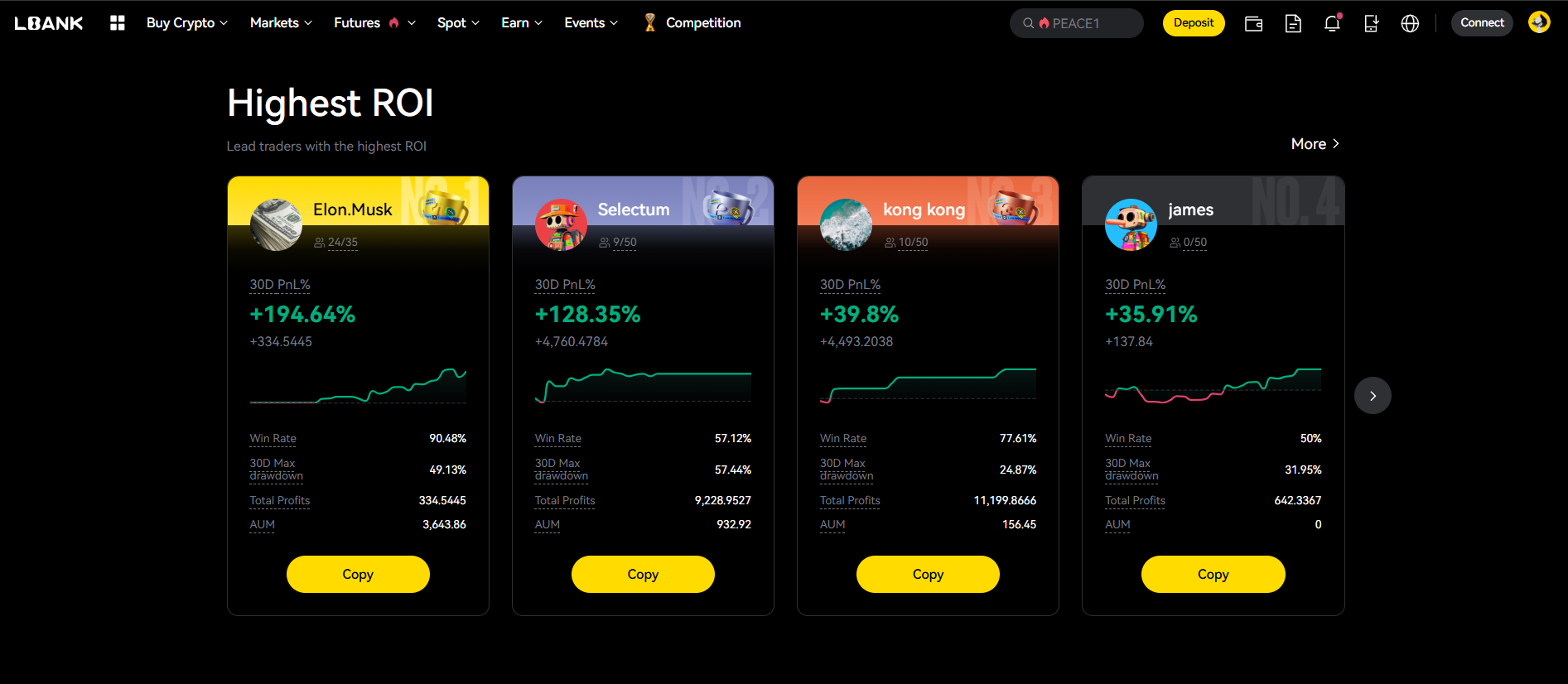
LBank launched copy trading years ago and refined it for futures-heavy markets. It supports over 800 coins with leverage up to 125x. The platform draws traders from the Asia-Pacific regions. Copy trading volumes grew steadily through 2025, with events like their Elite Trading Championship. LBank emphasizes transparency, allowing users to view metrics such as drawdown, win rate, and historical performance before choosing a trader.
This focus on transparency is reinforced by how data is presented. Traders are not judged on returns alone. Users can study equity curves, track consistency over time, and compare risk-adjusted performance across different market conditions. Metrics like maximum drawdown and profit factor help filter out high-risk strategies that may look attractive on the surface. This makes it easier to identify traders who prioritize capital preservation alongside growth, which is essential in leveraged environments.
Another key strength is how LBank structures participation through sub-accounts and flexible allocation systems. Users can isolate funds, experiment with different traders, and adjust exposure without affecting their main portfolio. Combined with percentage-based allocation tools, this allows for more controlled scaling as account size grows. Instead of relying on a single trader, users can build a diversified setup that reflects different strategies, timeframes, and risk levels.
ByBit
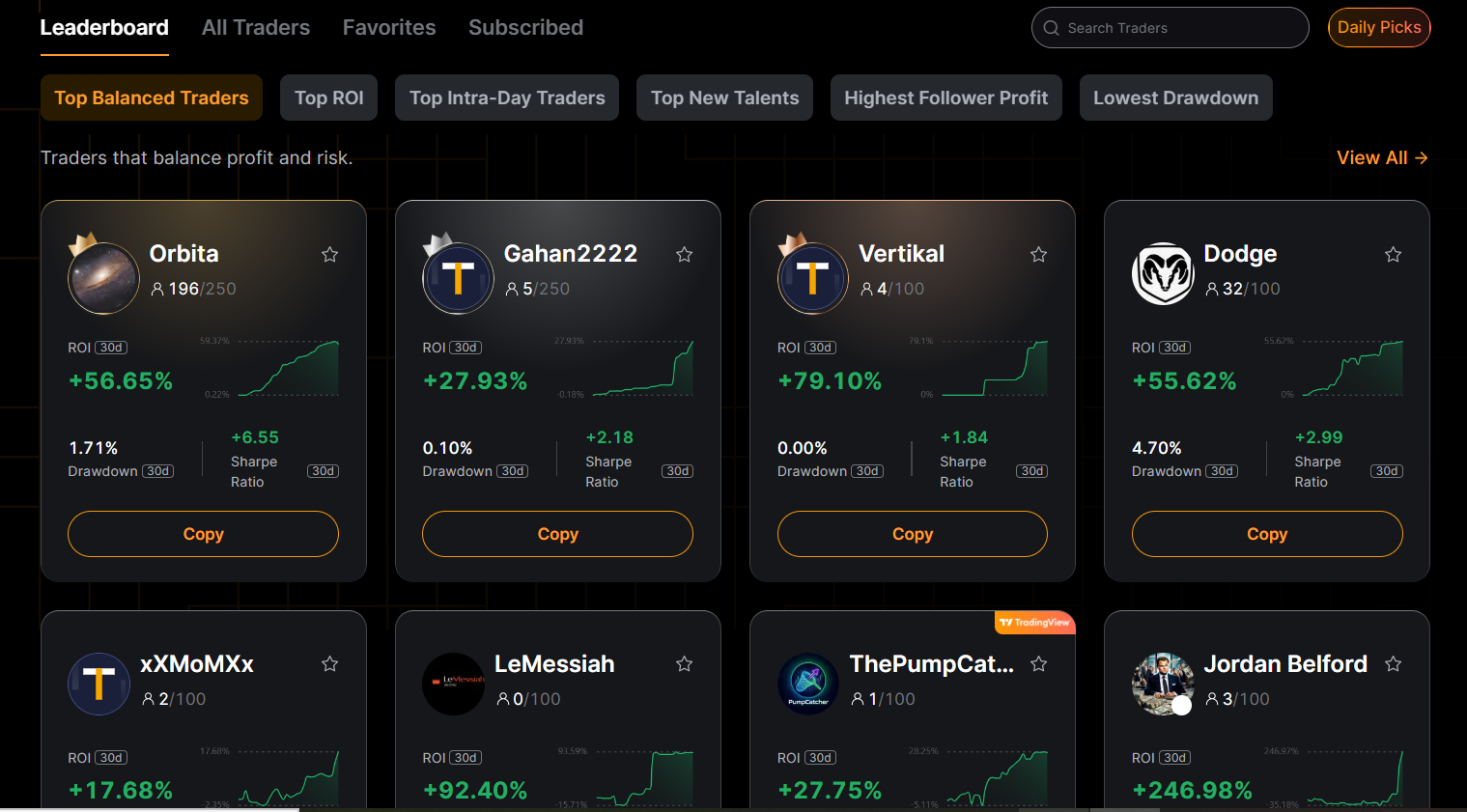
Bybit dominates in derivatives trading. It processes massive daily volumes, often ranking among the top exchanges globally. Copy trading appeals to its large user base, with thousands of lead traders available. The platform is known for its clean interface and strong educational resources that help users understand both trading and risk.
One of Bybit’s key advantages is scale. With a deep liquidity pool and high trading activity, execution is generally smooth, even during volatile market conditions. This matters in copy trading, where slippage can affect results. The large number of traders also means users can explore different styles, from high-frequency scalping to longer-term swing trading. However, this variety can be overwhelming, and filtering for consistency requires careful attention to metrics beyond simple return percentages.
Both platforms serve global users, including regions like Nigeria and Southeast Asia, and require KYC for higher withdrawal and trading limits. Bybit focuses on performance visibility and a wide pool of traders, making it attractive for users who want access to diverse strategies.
 SolanaSOL
 85.62-1.23%Feature Comparison
Allocation System
One of the biggest differences between the two platforms is how capital is allocated.
On LBank, the Smart Ratio system allows users to mirror a trader’s position size as a percentage of their account. If a trader risks 5 percent of their capital, your system applies the same percentage to your balance. This creates a more adaptive structure that scales naturally over time.
Bybit typically uses fixed allocation or contract-based sizing. While this can be easier to understand for beginners, it may not always reflect the trader’s level of conviction in each position.
In practice, percentage-based allocation tends to offer better long-term consistency, especially when combined with proper risk caps.
Risk Management Tools
Risk management is where many copy trading accounts succeed or fail.
LBank uses a sub-account system that isolates copy trading funds from your main balance. This reduces the risk of losses affecting your entire portfolio. Users can also set allocation caps and stop-loss limits to control exposure.
Bybit provides risk limits and stop conditions as well, but its structure is more closely tied to its derivatives trading engine. While effective, it may require a bit more familiarity with trading concepts to configure properly.
Both platforms allow you to stop copying a trader at any time, but LBank’s isolated setup makes it easier to manage multiple strategies without overlap.
Transparency and Trader Data
Choosing the right trader is more important than choosing the platform. This is where transparency matters.
LBank provides detailed metrics, including:
- Maximum drawdown
- Assets under management
- Win rate
- Profit factor
These metrics help users evaluate consistency rather than just headline returns.
Bybit also offers performance data, but the depth and presentation can vary depending on the trader. Some profiles focus heavily on ROI, which can be misleading without context.
For long-term sustainability, metrics like drawdown and profit factor are more useful than raw returns.
Fees and Profit Sharing
Both platforms use a profit-sharing model where lead traders earn a percentage of profits generated for followers.
Typical ranges:
- LBank: around 10 to 20 percent profit share
- Bybit: similar range depending on trader level
In both cases:
- Fees apply only when trades are profitable
- Losses are not reimbursed
Trading fees also apply separately based on the platform’s standard fee structure.
While the fee difference is not significant, it is still important to consider when calculating long-term returns.
User Experience
Ease of use can make a big difference, especially for beginners.
LBank focuses on a straightforward setup:
- Clear onboarding
- Simple allocation controls
- Easy access to trader metrics
Bybit offers a more advanced interface, which experienced traders may prefer. However, new users may need time to understand all available options.
In general:
- LBank is easier for beginners
- Bybit offers more depth for experienced users
Performance and Strategy Insight
Platform choice matters less than trader selection. A poor pick tank returns on any site. Focus on MDD under 30%, AUM over $500K, and profit factor above 1.5. Realistic monthly returns range from 2-8% after fees, depending on market conditions.
Diversify across 3-5 traders. Allocate no more than 25% per person. Rebalance monthly based on 30-day stats. Backtests show diversified portfolios cut volatility by 40% while preserving upside. In 2026, futures copy trading outperforms spot due to leverage. Monitor funding rates to avoid prolonged holds.
Metric | LBank Typical | Bybit Typical |
|---|---|---|
Avg MDD (Top Traders) | 20-35% | 25-40% |
Profit Factor | 1.4-2.0 | 1.5-2.2 |
AUM per Top Trader | $1M+ | $2M+ |
Pros and Cons
LBank Pros
- Sub-account isolation protects main funds.
- Smart Ratio scales naturally.
- Loss vouchers ease entry.
- Strong futures focus.
LBank Cons
- Interface is less refined.
- Fewer educational guides.
- Smaller trader pool.
Bybit Pros
- Intuitive design and app.
- More allocation options.
- Deeper performance metrics.
- Higher liquidity.
Bybit Cons
- No sub-account separation.
- Steeper learning for advanced modes.
- Crowded leaderboards.
Which Platform Is Better for You?
The answer depends on your goals and experience level.
- Beginners may find LBank easier to use due to its structured setup and simpler controls
- Risk-conscious users may prefer LBank’s sub-account system and percentage-based allocation
- Experienced traders may lean toward Bybit for its advanced tools and broader ecosystem
- Smaller accounts benefit from systems that allow flexible scaling, which gives LBank an advantage
- Neither platform is universally better. The right choice depends on how you plan to use copy trading
Common Copy Trading Mistakes
Many users struggle with copy trading, not because of the platform, but because of how they use it.
Common mistakes include:
- Choosing traders based only on high returns
- Ignoring drawdown and risk metrics
- Allocating too much capital to a single trader
- Not setting stop-loss or allocation limits
- Expecting consistent profits without monitoring performance
Avoiding these mistakes often improves results more than switching platforms.
FAQs
Is copy trading a reliable form of passive income?
Copy trading can generate consistent returns when managed properly, but it is not guaranteed. Results depend on trader selection, allocation strategy, and market conditions.
Which platform is safer, LBank or Bybit?
Both platforms provide risk management tools. Safety depends more on how those tools are used than on the platform itself.
What is the minimum capital required?
Minimum requirements vary, but many users start with around $100. Larger balances allow better diversification and risk control.
Can you lose money with copy trading?
Yes. Losses are possible and should be expected. Proper risk management helps reduce the impact.
Can you copy multiple traders at once?
Yes. Both platforms allow diversification across multiple traders, which is recommended for better risk control.
Conclusion
Copy trading has become a practical way to participate in crypto markets without trading full-time. Both LBank and Bybit offer solid systems, but they approach the process differently.
LBank focuses on structure, simplicity, and risk isolation. Bybit offers depth, scale, and advanced trading integration.
The key takeaway is that the platform is only part of the equation. Long-term success comes from disciplined allocation, careful trader selection, and consistent risk management.
If you treat copy trading as a system rather than a shortcut, it can become a useful tool for building steady exposure to the crypto market over time.
Which platform would you choose for copy trading
LBank (structured + risk control)
Bybit (more traders + volume)
I’d use both for diversification
Still deciding / researching