Mastercard Tests Stablecoin Settlement with SoFiUSD to Modernize Global Payments

The world of payments is quietly but surely updating one of its most vital pieces of infrastructure in decades. Rather than replacing the existing card networks, it is working to rebuild them from
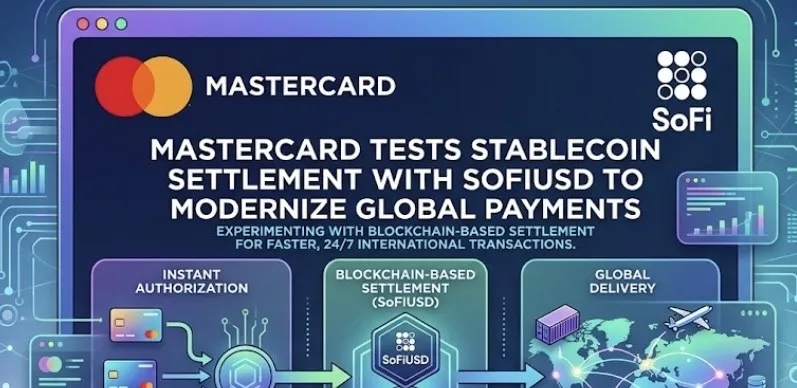
The world of payments is quietly but surely updating one of its most vital pieces of infrastructure in decades. Rather than replacing the existing card networks, it is working to rebuild them from the inside out. The newest one to get this treatment is Mastercard, which is now trialing stablecoin-based settlement with the regulated digital dollar, SoFiUSD, using Mastercard‘s partner, SoFi.
The objective is not to alter consumers’ payment methods those will continue to be electronic and fairly simple to run rather to drastically reform the financial-back-end processing.
A Shift in the Back-End of Card Payments
In normal card networks, it looks like a customer spending money is instantaneous but in fact the movement of money between banks between the various parties is done at a later stage via a complicated clearing and settlement process that may take hours/days no matter the system in place.
This back end layer is where Mastercard‘s new approach offers to introduce stablecoins. Instead of going through conventional correspondent banking rails banks, perhaps in the near future, will be able to settle liabilities with regulated digital dollars on a blockchain infrastructure.
This implies that consumers will still use cards in the same way as now, but one step up in the settlement layer will be faster, more efficient and perhaps even operate 24/7.
The Role of SoFiUSD in the System
This experiment is centered on a dollar-backed stablecoin called SoFiUSD issued through a partnership with SoFi Technologies.
SoFi Bank (a US nationally chartered bank) plans to utilize SoFiUSD for the settlement of Mastercard credit and debit payments. Its stablecoin aims to keep a 1:1 ratio with cash reserves and therefore it is closer to a tokenized version of fiat currency rather than a speculative digital asset.
This construct is significant because it provides SoFiUSD with a regulated banking system that ties together traditional finance and crypto/blockchain.
Galileo Expands Access to Stablecoin Settlement
And another critical part of the thrust is Galileo Financial Technologies, the SoFi‘s payments platform.
Galileo, by providing access for other banks and fintechs linked to its platform, will enable those participating banks to choose to settle using stablecoin, with the system and infrastructure already established through Mastercard. This will essentially enable other financial institutions to also test the waters of blockchain settlement without the need to create their own system.
Mastercard will be a convincing reason to use stablecoins as away to make daily – day-to-day commerce more efficient by integrating at the infrastructure level, not by a revolutionized infrastructure.
Mastercard’s Multi Token Strategy
This initiative takes part of the larger vision of Mastercard through its Multi Token Network (also called MTN), a system envisioned to handle multiple kinds of digital representations of value, such as:
Stablecoins
Bank deposit tokens(loan substitutes)
Digital fiat currency (online currency]: digital currencies operated by issuing banks that are not secured by any physical objects or assets. Prices of these currencies are determined by the issuing banks and are independent of other assets or currencies.
Concept is not to do away with money, but to put in tokenized form so that it can move around in various form more efficiently.
Through the implementation of such a robust infrastructure layer, it seems to be creating itself the link between the old regime of banking infrastructure and the new one based on blockchain technology.
Why Stablecoin Settlement Matters
Once a transaction is approved, the stable coin settlement system takes over. While the consumer experience is unaffected, the efficiency of the backend system is improved tenfold.
Key benefits include:
Faster settlement between banks
Bank rails that are no longer utilized
Potential of Near real-time clearing
Reduced operational friction for cross-border payments
This is critical at the global level for payment networks that process billions of transactions a day.
Bridging Traditional Finance and Blockchain
The introduction of Mastercard is indicative of a wider industry that is now utilising blockchain technology into their current infrastructure rather than utilizing it to replace them. Rather than creating a needs for the consumer to adopt a crypto wallet of their spending behaviour, the technology is rather being built into current practices.
The policy has the advantage that it will be less frictional, yet still offer many of the efficiency advantages of decentralisation.
And making clear that the market is now starting to see that stable coins are functioning more as a tool for settlement in institutional finance, rather than as speculative crypto assets.
Implications for Banks and Fintechs
For banks and fintech companies this could definitely be a whole game changer to manage their liquidity and settlement risk. Transaction could can be settled OTC in real time with the use of tokenized dollars.
This could:
Improve capital efficiency
Reduce counterparty exposure
Speed up cross border payments
Lower operating costs
Though it has many drawbacks, one of its disadvantages is that it can create additional reliance on the blockchain infrastructure and the ambiguities about digital assets.
A Quiet but Major Financial Shift
Though an individual customer in the ground-level can see no immediate, apparent change, the consequences of the experiment are monumental. It is the slow but structural reorganization of the way that money flows on the back-end of the system of money in the world today.
Mastercard is laying the groundwork for the professionalization of the payments infrastructure by inserting stablecoins into its default settlement layer.
Conclusion
Working with bank account issuer SoFi and investigating a settlement using SoFiUSD is a significant move from Mastercard toward integrating conventional finance into blockchain. Rather than breaking the system that enables card transactions, they are enhancing it.
Backed by SoFi Technologies and powered by its Galileo platform, stablecoin settlement is leaving experimental crypto use cases behind and entering the mainstream financial infrastructure.
If this model gets off the ground, the payment systems could be entirely altered, making global settlement faster and more efficient, all while being more and more tokenized at scale.