MiCA-Compliant EURAU Stablecoin Launches in DeFi Game Changer for Europe?
 re****@gmail.com2026-04-22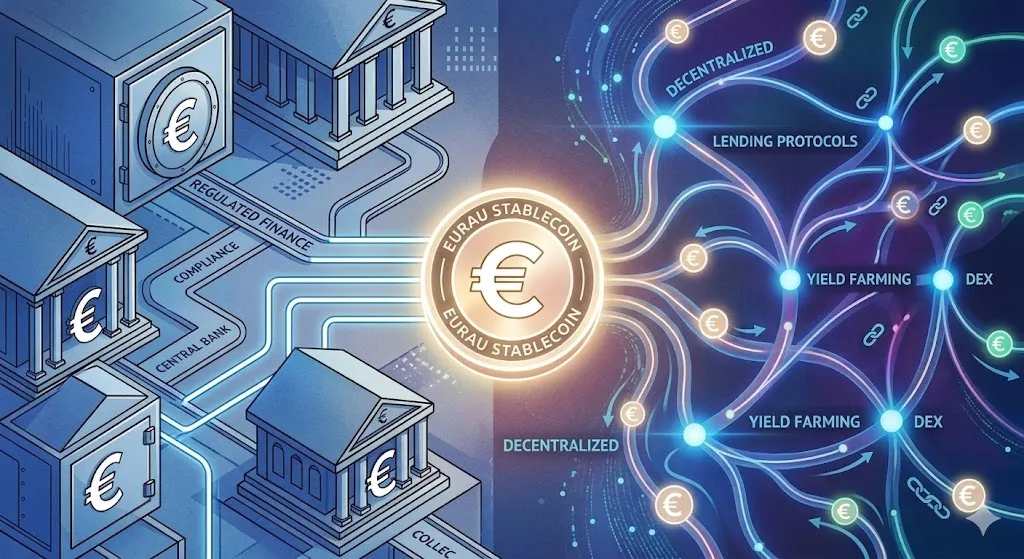
AllUnity's MiCA-compliant EURAU expands into DeFi liquidity pools on Uniswap and Raydium, testing whether regulated euro stablecoins can challenge dollar dominance in decentralized finance.
A fully compliant euro stablecoin just moved into Decentralized Finance and the timing couldn't be more tactical.
AllUnity, which is the joint-venture company behind EURAU (the euro stablecoin), is strategically expanding the stablecoin's use case from centralized to decentralized finance (DeFi) protocols. EURAU will be issued under MiCA — the EU's regulated cryptocurrency law — making EURAU one of the only regulated euro stablecoins currently available in the crypto market with a recognized legal status under EU law. Moving this stablecoin into DeFi is more than a product expansion; it is an experiment to see whether regulation and decentralization of finance can co-exist with one not compromising the other.
What AllUnity and EURAU Actually Are
DWS Group, Flow Traders, and Galaxy Digital formed AllUnity with the mission to revolutionize the on-chain economy by issuing a fully collateralized EUR-denominated stablecoin regulated by BaFin, Germany's financial supervisory authority. This differs from some startups trying to launch a stablecoin without compliance, regulation, or institutional backing. AllUnity has created EURAU by using established institutional players to build a fully compliant and regulated stablecoin according to European law.
EURAU is pegged to the Euro and is fully backed by reserves held in Euros, so it is guaranteed that the value of EURAU remains equal to EUR. By being classified as an Electronic Money Token (EMT) under MiCA, EURAU must be 100% backed by Euros, produce periodic attestation, and operate under an Electronic Money licence. The infrastructure for this compliance is concrete, objective and ongoing; it isn't just a box ticked at launch when EURAU launches but continually satisfies the requirements of compliance and regulation.
What AllUnity is doing now is providing access to this regulated asset within DeFi ecosystems, with EURAU now live across Ethereum, Optimism, Arbitrum, Base, and Solana — integrating with decentralised exchanges, liquidity pools, and lending protocols where EURAU will be used in the same way that US dollar-pegged stablecoins are currently used today.
Why DeFi Is the Real Battleground
While centralized exchanges are perceived to have a larger role in the cryptocurrency space, it is in decentralized finance (DeFi) where the market share for stablecoins takes form.
Stablecoins are the underpinning for virtually every transaction on decentralized networks; they are used as a form of collateral for lending markets, are the fiat-leg of trading pairs, and serve as the settlement asset for yield farming strategies. The entity which controls the dominant stablecoin in DeFi also has a huge portion of control over how value flows through that ecosystem.
Currently, the dominant players are Tether and USD Coin, both of which are dollar-pegged stablecoins and are both actively used throughout all major DeFi protocols. More than 90% of fiat-backed stablecoins are pegged to the US dollar, with Tether and USDC accounting for 93% of the total stablecoin market capitalization. A euro-pegged stablecoin that is only currently available through centralized exchanges has limited utility; however, once DeFi liquidity is established for a euro stablecoin, it will provide a credible alternative for euro-pegged stablecoins built on decentralized protocols.
In addition to establishing euro stablecoin liquidity in the DeFi ecosystem, the DeFi movement is also testing a new frontier — the viability of MiCA-compliant assets operating in a permissionless environment. DeFi protocols do not require credential verification or enforce geographic restrictions by default. So, when a MiCA-compliant stablecoin is plugged into DeFi protocols, significant questions are raised about how the compliance obligations associated with MiCA would be enforced in a decentralized environment characterized by a lack of central authority responsible for holding anyone accountable.
The Compliance Tension Is Real
Although this situation appears to be convoluted, those who have closely monitored the activities of AllUnity should keep an eye on their pursuit. MiCA places obligations on the issuer (AllUnity); they are created by and the responsibilities for MiCA is with AllUnity, and not with every protocol that has decided to issue EURAU which creates space for some breathing room. EURAU can move freely within DeFi, just as a euro bank note moves without the European Central Bank (ECB) monitoring every transaction.
However, this analogy only goes so far. There have been questions already being raised by regulators around how stablecoins are being utilized in DeFi, specifically: Are there any AML obligations? Is there a requirement for the firm to screen their transfers against any applicable sanctions? Does the issuer of the token hold responsibility or liability for how their token is utilized once it has been issued on-chain?
No one has answered these questions yet, but by the time EURAU is operating at full scale within DeFi, it will force these questions into focus quicker than regulators would like. Cointelegraph contacted AllUnity for comment regarding potential conflicts with EU regulation but did not receive a response at the time of publication.
Because of AllUnity's institutional backing, it provides a higher level of credibility and longevity than many stablecoin projects; however, it increases the firm's risk to regulatory friction in comparison to a non-identified group developing a stablecoin. As AllUnity progresses into the world of permissionless DeFi, their course of actions will go a long way in determining where they believe the lines are drawn.
What This Means for the Euro's Digital Future
France's Finance Minister recently backed euro-pegged stablecoins as a matter of financial sovereignty, warning that Europe's digital payments infrastructure remains too reliant on U.S.-dominated rails. The European Central Bank is still developing its Digital Euro, with a pilot exercise only potentially starting in mid-2027 and a possible first issuance not until 2029 — on a timeline that keeps slipping. European Central Bank Meanwhile, dollar stablecoins keep accumulating market share in every corner of crypto — including DeFi markets that are increasingly consequential for how real financial activity gets settled globally.
EURAU moving into DeFi is the most concrete attempt yet to reverse that trend through the private sector. It has regulatory legitimacy that no dollar stablecoin operating in Europe can fully claim under MiCA. It has institutional backing that gives it longevity. What it doesn't have yet is liquidity depth and user adoption at the scale needed to actually displace dollar instruments from their default position.
That's the work ahead. AllUnity has built the foundations. DeFi integration is where the real test begins.