Paulson Warns of "Vicious" Treasury Shock; Urges Contingency Plan
 lu****@gmail.com2026-04-23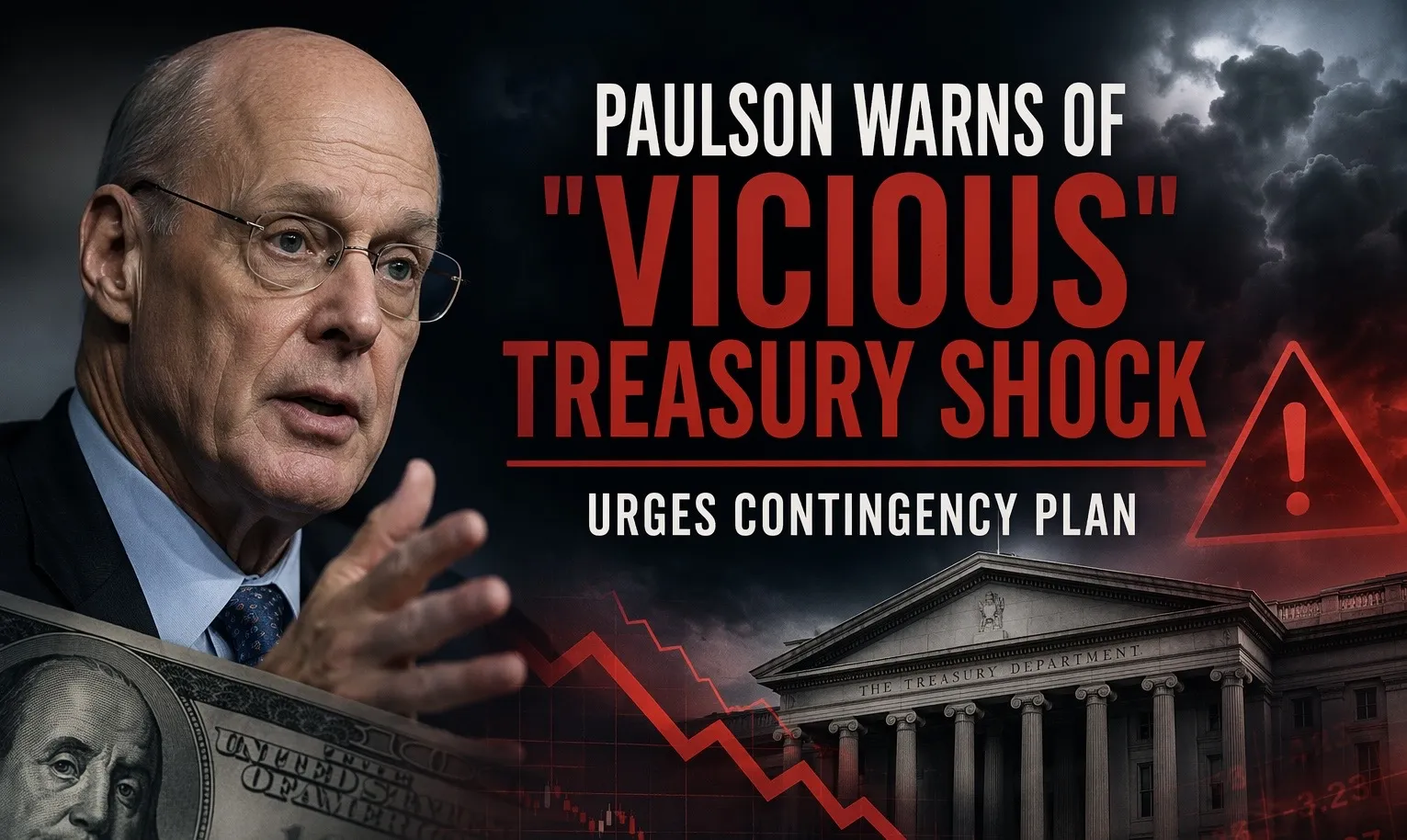
Henry Paulson warns of a potential “vicious” shock to US Treasurys, urging policymakers to prepare an emergency plan as rising debt and weakening demand threaten global financial stability.
A prominent warning has been given to the United States government bond market by the former US Treasury Secretary, Henry Paulson, who has warned policy makers to have an emergency back-up plan in case of a potential collapse in the demand of US Treasurys. He termed the possible consequences as vicious and said that governments should not act when the crisis starts to develop the response mechanisms.
In discussing an interview with Bloomberg on Thursday, Paulson asserted that the United States should have a break the glass style emergency plan that is focused, short-run, and is available at any time in case market conditions worsen at an alarming rate.
Paulson said that we have to have a break-the-glass plan on the shelf which is very specific and short term in case we have hit the wall.
He then said that, although it is impossible to foresee the time of any crisis, it is worth preparing in advance since the results of reaching a critical breaking point in Treasury demand might be disastrous and disrupting.
“When we hit it, it will be vicious, so we have to prepare for that eventuality,” he said.
The reasons why US Treasurys matter to the global financial stability
The American Treasury market is generally considered to be the heart of the world financial system. The United States government bonds are regarded as the closest tool to a so-called risk free asset, i.e. they are used as a reference point to the pricing of virtually all other financial instruments.
Treasury yields affect corporate bonds, the mortgage rate, the cost of bank lending and even the value of equity. Due to this pivotal position, instability in demand of the US government debt might have far-reaching consequences on other markets worldwide.
In case investors start losing their trust in Treasurys or require much higher yields to offset the perceived risks, the cost of borrowing money in the whole financial system might soar.
Rising debt levels and growing market concerns
The ominous warning that Paulson has given is against a growing alarm regarding the size of the US government debt, which is already over 39 trillion dollars. When the debt increases, the interest payments increase by an amount per year, which is an extra burden on federal finances.
At the current time, the returns on 10 years Treasury are approximately 4.3 percent, which indicates not only the expectations of inflation, but also the demand of investors to hold the US debt. But, in case of market confidence, the investors may require even more returns which will make being a government in the US even more expensive.
The increased yields would also increase interest payments on the existing debt, increasing the federal deficit. This is a dynamic that economists refer to as a feedback loop as the increase in debt will raise the cost of borrowing, which will result in yet increased accumulation of debt.
The feared “doom loop” scenario
Over the years, there has been a series of warnings by economists and market analysts of a so called doom loop situation where investors become increasingly doubtful over the sustainability of US fiscal policy.
Over the situation, investors might be more demanding on the premiums of risk on government bonds due to fears of increased levels of debt and the lack of long term fiscal balance. With the increase in yields, the government would incur more interest payments, rendering deficits bigger and adding to the fiscal sustainability worries.
Such a self reinforcing cycle may put extra strains on the financial markets especially when it happens quickly or at a time when the whole economy is in a state of greater instability.
Although such consequences are hypothetical, the remarks made by Paulson indicate the increasing interest among policy makers and economists on the issue of long term structural risks in sovereign debt market.
Federal Reserve role in a stress scenario
Among the most important questions that analysts have is what will happen should demand of US Treasurys suffer greatly at the time when the government will still have to fund expenditure and roll over maturing debts.
Under such a situation, there are market observers who opine that the Federal Reserve may have no other option but to intervene and become a large-scale purchaser of government securities to stabilize the situation and make sure the financial system does not collapse.
According to Bloomberg reporting, this form of intervention would amount to central bank subsidy of government borrowing requirements, a move that would have a profound effect on inflation, independence of monetary policy and confidence in the long term markets.
Although the Federal Reserve has been involved in large scale bond buying programs in past times of financial stress, including quantitative easing after the financial crisis of 2008 and during the COVID 19 pandemic, sustained intervention to bail out fiscal financing would be a more radical way of providing market support.
Why Paulson is calling for preemptive planning
The fact that Paulson focuses on preparation indicates how hard it is to react to financial crises on the spot. Once confidence goes, markets can change quickly and this gives limited time to policymakers to create new structures under pressure.
He is implying that authorities should pre-establish clear response tools by arguing in favor of a pre established contingency plan, and not to improvise during a crisis event.
This plan may even involve such things as temporary liquidity facilities, emergency bond purchase programs or even synchronized fiscal and monetary policies that are meant to stabilize the demand on government debt.
The main point is that in case of a shock to the Treasury demand, the reaction should be swift and strong to avoid the expansion of the contagion to other financial markets.
International effects of Treasury market volatility
Since US Treasurys are used as the standard of world risk free assets, any instability in their stability would spread well beyond the United States.
There are large holdings of US government debt by international central banks, sovereign wealth funds, pension funds, and financial institutions. A sharp change in the dynamics of Treasury markets may thus have an impact on the global liquidity situation, exchange rates and cross border capital flows.
In a worst case, the volatility in the US debt markets may cause the repricing of risk in various asset classes such as equities, corporate credit as well as the emerging market debt.
It is this interrelatedness that explains why the US Treasury market is not only considered by many economists as a domestic financial tool, but also as a pillar of world economic stability.
Conclusion
The caution given by Henry Paulson underscores increasing worries regarding the long term sustainability of the US Treasury market in the face of increasing debt levels and changing investor dynamics. His call to a preemptive break the glass contingency plan is an indication that though the crisis will not happen, the effects of a sudden collapse in demand of the US government debt may be dire and far reaching.
With the world financial systems still being strongly pegged to US Treasurys any long term instability would have not only an implication to the United States but also to the world markets and economies. The question now is whether policymakers ought to move forward and prepare to such eventualities or remain dependent on the conventional market faith to support the system.