Philippines SEC Flags dYdX and Six Crypto Platforms as Unauthorized
 ra****@gmail.com2026-04-23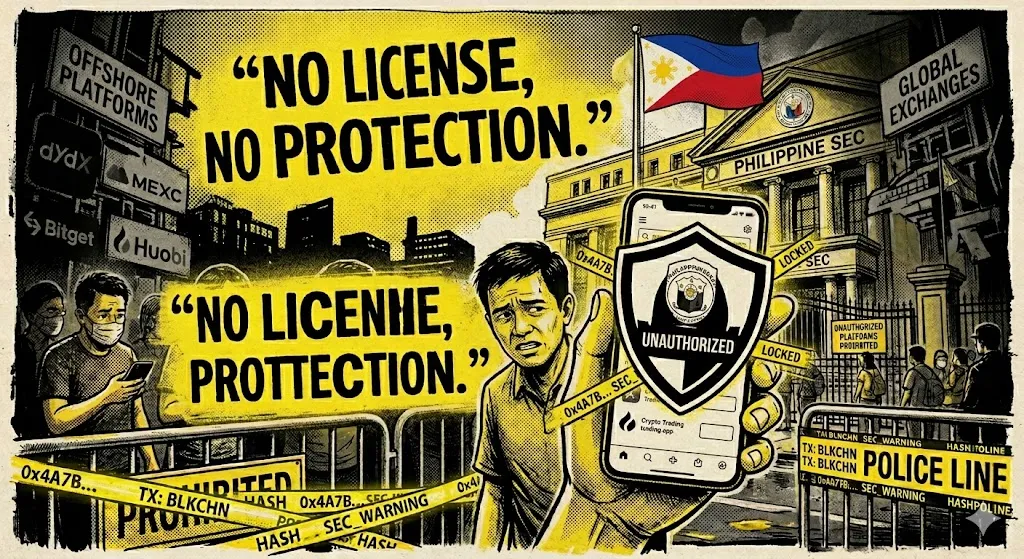
The Philippines SEC flagged dYdX and six crypto platforms as unauthorized, warning investors and promoters of fines up to PHP 5M or 21 years imprisonment under the country's CASP framework.
The SEC warns the public that they should not invest in dYdX, Aevo, gTrade, Pacifica, Orderly, Deriv, or Ostium because they are all unlicensed to operate as a regulated broker or investment platform in the Philippines. In an advisory that was posted on the SEC's official Facebook page on Tuesday, they stated that they had conducted a review and concluded that all of these platforms are not registered with the SEC and do not have either a license to operate or an authorisation under the Philippines' regulation of cryptocurrency service providers.
These platforms appear to be non-compliant with securities regulations, per their offer of investment in exchange for anticipated returns, profits, or interest, which means that they are operating as unlicensed or unregulated broker-dealers.
What the CASP Framework Actually Requires
The CASP framework was adopted by the Republic of the Philippines in order to establish a more regulated environment within a largely unregulated sector. A CASP license is now required for any company providing crypto-based services in the Philippines. Among other things, companies seeking a CASP license have to provide at least the minimum amount of capital, meet all standard operational requirements, and also have credibility when soliciting funds from Filipino investors.
The seven flagged platforms do not currently fit this definition. They do not have a 'CASP'; therefore, there is no legal basis for these companies or for anyone promoting these companies domestically.
The SEC has clearly stated that individuals who promote these platforms within the Republic of the Philippines may be subject to criminal liability. If convicted, they would be subject tofines of up to PHP 5 million, or a sentence of up to 21 years in jail. This is not just a slap on the wrist, but rather imposes significant risk and liability on influencers, their affiliates, and local agents advancing unregistered offshore companies.
The Seven Flagged Platforms
Several of these are well-known in the decentralized finance space. dYdX is one of the largest decentralized perpetuals exchanges by trading volume globally. Deriv has a substantial retail following across Southeast Asia. Their size does not change their status in the Philippines — unregistered is unregistered.
This Is Part of a Pattern
On Tuesday, the SEC of the Philippines took another step in its crackdown on the unlicensed cryptocurrency firms that have been operating within the country for the past two years. The recent activity in August of being named by the SEC as operating without a license and placing investors at risk by allowing them to use their platform, then the subsequent suspension of services by Binance, the removal of Binance's app from the App Store and Play Store due to failure to meet requirements placed on it, and subsequently the inability of users in the Philippines to access the main Binance website.
After this action occurred, the SEC took similar actions against both Coinbase and Gemini on December 24, 2025, as part of this ongoing enforcement of its regulations. The SEC began its enforcement actions against cryptocurrency exchanges with public notices alerting the public to take caution when dealing with unlicensed exchanges. However, it has transitioned to a more active enforcement strategy by removing access from licensed exchanges from Filipino consumers, as opposed to simply issuing advisory notices.
The Investor Risk Angle
The SEC's concern with unlicensed platforms is not abstract. When a crypto platform operates outside any regulatory framework, there is no mandatory capital buffer, no required audit, no enforceable complaint mechanism, and no clear path to recovery if funds go missing. Users of unregistered platforms have no meaningful recourse if a platform freezes withdrawals, collapses, or simply disappears.
For derivatives platforms in particular — and most of the flagged seven fall into that category — the risks compound. Leveraged trading amplifies losses. An unregistered platform offering leveraged crypto products to retail investors, without any local licensing or capital requirements, is exactly the scenario regulators are trying to prevent.
Where This Leaves Filipino Crypto Users
The Philippines has a large and active retail crypto market. Filipinos have shown consistent appetite for crypto products, including the higher-risk derivatives that several of these platforms specialize in. The SEC's actions narrow the menu of accessible platforms but do not eliminate demand.
For now, the advisory stands as a formal warning. Whether access restrictions follow — as they did with other exchanges — depends on whether the flagged platforms move to comply or continue operating as if the Philippine market does not require their attention.