Prediction Markets in Crypto: How Platforms Like Polymarket Are Turning News Into Trades

The article explores how platforms like Polymarket use blockchain to turn news into tradable assets, outperforming traditional polls through financial incentives and institutional-grade data.
Most financial products require you to have a view on price. You think Bitcoin goes up, you buy. You think it goes down, you short. Prediction markets work on a different axis entirely. They ask you to have a view on events. Will the Fed cut rates in May? Will there be a US-Iran diplomatic meeting before April 18? Will Bitcoin hit $100K by December 31?
These are not technical analysis questions. They are judgment questions. And for the first time in financial history, your judgment on geopolitics, macroeconomics, elections, and breaking news can be monetized in real time, on-chain, without a brokerage account.
That is the core of what prediction markets do. And over the past 18 months, they have moved from a niche crypto experiment into something that Wall Street, intelligence agencies, and major news networks are paying serious attention to.
What Prediction Markets Actually Are
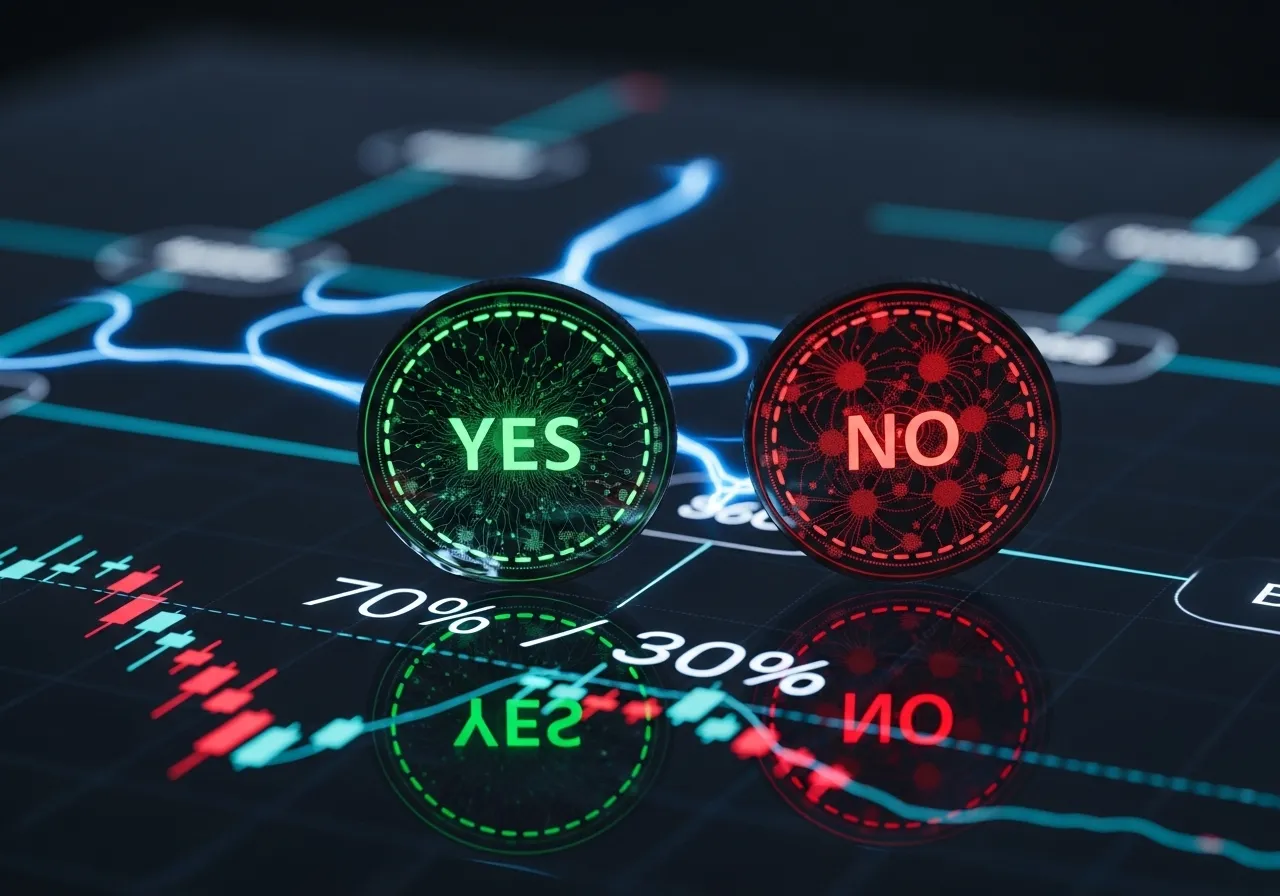
A prediction market is a trading platform where you buy and sell shares tied to the probability of a future event happening. Each share represents a yes-or-no outcome. If shares for a given outcome trade at $0.70, the market is pricing in a 70% probability of that event occurring. If you believe the actual probability is higher, you buy shares. If you think it is lower, you sell or buy the opposing outcome.
If your prediction proves correct, your shares become worth $1 each when the market resolves. If you are wrong, your shares become worthless.
The profit mechanism is straightforward: buy low, be right, collect the difference. Every dollar staked is real capital, which is exactly what separates prediction markets from opinion polls and Twitter consensus. People can say anything when there is nothing on the line. When money is involved, the average quality of judgment goes up.
Two theoretical frameworks support why prediction markets should excel at forecasting. The first is the wisdom of crowds: the median judgment of a large, diverse group of people operating independently tends to be more accurate than any single expert's view. The second is the efficient market hypothesis, which holds that prices encode all available information, reflecting the collective judgments of profit-seeking traders.
Combined, these two principles create a market structure where accurate predictions are rewarded financially, bad predictions lose money, and the price of each outcome share functions as a live probability estimate that anyone in the world can read and trade on.
How the Technology Works Under the Hood
Crypto prediction markets are built on blockchain infrastructure, and the architecture is what makes them genuinely different from traditional betting or forecasting platforms.
The industry standard for smart contract logic is the Gnosis Conditional Tokens Framework. This system manages outcome share creation so that one USDC of collateral mints one full set of outcome shares. The combined value of all outcome shares always equals the original collateral, enabling risk-free arbitrage that keeps prices accurate and prevents the market from drifting away from genuine probability estimates.
Polymarket, the dominant player in the space, operates on the Polygon blockchain and settles all trades in USDC. It uses a hybrid model: off-chain order matching for speed, with on-chain settlement so the actual execution of funds happens on the blockchain, where nobody can tamper with it.
When you place a limit order on Polymarket, the system automatically shows a mirrored order for the opposite outcome. You are trading against other users, not against a house. No counterparty has a structural interest in your losing.
The resolution mechanism is where it gets technically interesting. Outcomes are verified using the Universal Market Access Optimistic Oracle, a third-party service that connects smart contracts to real-world data. The oracle assumes an outcome is true unless a user disputes it by staking tokens. Any dispute is escalated to UMA's data verification mechanism, where UMA token holders vote to determine the outcome.
When an event ends, the decentralized oracle checks the final result, records it on the blockchain, and smart contracts automatically pay out to holders of the winning outcome without any manual intervention or withdrawal delays.
This is a fully automated payout infrastructure. No customer service ticket. No withdrawal request is sitting in a queue. The contract runs, the oracle confirms, and funds move.
The Numbers That Got Wall Street's Attention
For most of its early life, Polymarket was a curiosity. Trading volume was modest, the user base was small, and the events on offer were mostly crypto-native. The 2024 US presidential election changed that permanently.
Polymarket processed approximately $22 billion in notional trading volume throughout 2025. It hit a record $7 billion in monthly trading volume in February 2026, and on February 28, 2026, it processed $425 million in a single day. By early 2026, the platform reported over 450,000 active traders.
Monthly unique wallets nearly tripled in the six months leading up to February 2026, reaching 840,000. The growth was driven not just by larger bets from existing users but by a broad expansion of the participant base.
The category of events being traded also expanded well beyond elections. A single market, "Will the US strike Iran by February 28, 2026?", attracted $73 million in February 2026, the largest geopolitical contract in Polymarket's history. Volumes also diversified into tariff policy markets, Ukraine ceasefire scenarios, and China-Taiwan tensions.
The institutional signal came in October 2025 and is hard to overstate. The Intercontinental Exchange, the parent company of the New York Stock Exchange, invested $2 billion into Polymarket, valuing the platform at $9 billion, and launched specialized data tools that feed prediction market sentiment directly to Wall Street trading desks. ICE gained exclusive rights to distribute Polymarket's real-time probability data to institutional investors. In February 2026, ICE launched the "Polymarket Signals and Sentiment" tool, which major hedge funds now use to gauge immediate crowd sentiment on macroeconomic events faster than traditional news networks can report them.
That last part is worth letting sink in. Hedge funds on Wall Street are now watching what a crypto prediction market says about a Fed rate decision before the news cycle catches up.
Why These Markets Are More Accurate Than Polls
The 2024 US presidential election was the proof-of-concept moment that nobody expected. Polymarket had the odds of Donald Trump winning at 95% before midnight on election day, several hours before the Associated Press called the election. Polymarket predicted the outcome more accurately than traditional polls, particularly in swing states.
Political polling was already facing a crisis of confidence. Response rates had been declining for decades, and Trump voters had been systematically undercounted in 2016 and 2020. The polls forecast the presidential election as a coin toss. Prediction markets favored Trump at roughly 60% odds throughout, and turned out to be right.
The structural reason prediction markets beat polls is not magic. It is incentives. Forecasting without financial consequences rewards confidence over accuracy. Prediction markets make people bet real money on what they believe will happen. Wrong bets lose money. The result is a real-time probability signal that filters out ideological noise and performative takes.
The Iowa Electronic Markets outperformed 74% of polls across five US presidential elections from 1988 to 2004. Research on combined forecasting found that integrating polls, prediction markets, and quantitative models reduces error by 16 to 59% compared to any single method used alone.
Polymarket's own accuracy data supports this. Polymarket odds are accurate over 94% of the time, a full month before a market resolves, rising above 96% within four hours of resolution. The platform's Brier score, a statistical measure where lower numbers indicate better calibration, sits at 0.0843 across resolved markets. When Polymarket prices indicate a 70% probability, the corresponding outcome happens roughly 70% of the time.
The deeper liquidity gets, the more accurate the signal becomes. In markets with liquidity above $1 million, Brier scores fall as low as 0.0247, which represents an exceptionally high accuracy rate, suggesting that as capital flows into prediction markets and infrastructure matures, accuracy will continue to improve.
What You Can Trade On Right Now
If you have never used a prediction market, the range of available markets is wider than most people assume. The category started with politics and elections, but has expanded significantly.
On any given week on Polymarket, you will find active markets on Federal Reserve rate decisions, Bitcoin price levels across different time horizons, geopolitical flash points like Iran-Israel military action, major sports championships, corporate earnings outcomes, and cultural events ranging from award shows to viral internet moments.
Volume is now diversifying across categories. Sports, crypto, and politics each contributed substantially in recent weeks, with the economy, weather, and culture adding further breadth. This diversification is what separates structural growth from event-driven spikes. Sustained multi-category volume across these verticals points to a user base that engages regularly, not just during election cycles.
The mechanics of participating are straightforward. You deposit USDC into your Ethereum wallet, approve the necessary exchange contracts, browse markets, choose your outcome, buy shares, and then either trade those shares at any time before resolution or hold until the outcome is determined. Each share costs between one cent and one dollar, reflecting the market's current probability estimate.
You can also use Polymarket without trading at all. The probability data is publicly visible and functions as a free, real-time information feed. Many people check Polymarket odds the same way they check financial news, not to trade, but to understand where informed collective judgment sits on a given question.
The Risks That Come With This Territory
Prediction markets are genuinely useful. They are also genuinely risky in ways that are easy to underestimate when you are looking at a clean interface and real-time probability feeds.
Binary outcomes mean total loss on the wrong side. Unlike a stock position that can lose 30% and recover, a prediction market share goes to zero if your outcome does not occur. There is no partial credit. Position sizing matters enormously in this environment, and the tendency to overestimate your edge on a complex geopolitical question is a constant hazard.
Thin liquidity can create misleading odds. The accuracy benefits of prediction markets scale with the size of the market. Small trading volumes mean bets from large investors can skew the market significantly. Polymarket saw heavy one-sided betting during October 2024 from a single individual located in France, demonstrating that in less liquid markets, a single large actor can temporarily distort the probability signal. A market with $50,000 in volume is not the same quality of signal as one with $50 million.
Oracle disputes can delay resolution. Markets sometimes resolve later than expected when the outcome is ambiguous, and disputes are filed through the UMA mechanism. If you are planning your capital around a specific resolution date, unexpected delays can create liquidity problems.
The regulatory landscape is still developing. In 2026, Polymarket operates a dual structure: a federally regulated "Polymarket US" platform available to American citizens, and a global platform restricted from the US and select European nations. The platform acquired QCEX, a CFTC-licensed exchange, for $112 million to support its US re-entry, with American users now subject to strict KYC requirements. Regulatory posture toward prediction markets varies widely by jurisdiction, and users outside the US should verify what is accessible and legal in their own countries before depositing funds.
Airdrop farming inflates volume figures. Thousands of users are executing high-frequency trades across markets, hoping that consistent volume and liquidity provision will qualify them for a highly lucrative token airdrop when the POLY token eventually launches. This airdrop-farming behavior inflates headline volume numbers in ways that make the market look more liquid than it functionally is for genuine traders.
What Prediction Markets Mean for How You Read News
Beyond the trading opportunity, prediction markets have a secondary use that many crypto-native investors overlook: they are one of the most useful calibration tools available for understanding real-time market sentiment on events that will affect crypto prices.
If you want to understand how the market collectively weighs the probability of a Fed rate cut before the next meeting, a single Polymarket contract gives you that in one number, updated in real time, backed by money. No need to read through competing opinion pieces, conflicting analyst reports, or a 45-minute Twitter debate. The price on the contract reflects what people are willing to bet.
Prediction markets' dynamic, real-time nature means that as new information becomes available or sentiments shift, contract prices adjust almost instantaneously. This immediate response contrasts with the slower, often bureaucratic processes of traditional information collection and analysis.
By 2028, the consensus is that the question will no longer be "what do the polls say?" but "what does the market say?" Standalone prediction market platforms are also likely to be absorbed into broader financial infrastructure. Robinhood, Coinbase, CME, and Nasdaq are all building event contract capabilities. The category is being embedded into traditional finance rather than remaining a separate vertical.
The era of prediction markets as a fringe crypto product is already over. ICE's $2 billion investment made that official. The question for investors and traders now is not whether these markets matter, but how to use them well.
Key Takeaways: The Prediction Market Revolution
- A New Trading Axis: Unlike traditional finance, which trades on price, prediction markets trade on events. They allow you to monetize your judgment on geopolitics, macroeconomics, and news rather than just technical chart patterns.
- Incentivized Accuracy: These markets consistently outperform traditional polling and expert "punditry" because participants have skin in the game. Financial loss is a powerful filter that removes ideological noise and rewards objective reality.
- Institutional Integration: Prediction markets are no longer a "crypto experiment." With the Intercontinental Exchange (ICE) investing $2 billion and launching specialized sentiment tools, Wall Street is now using this data to front-run traditional news cycles.
- Decentralized Infrastructure: Platforms like Polymarket rely on Optimistic Oracles (UMA) and Smart Contracts (Gnosis) to ensure that payouts are automated and immune to human tampering or central authority intervention.
- Binary Risk/Reward: While highly accurate, these markets are high-risk. Outcomes are binary (100 or 0), meaning there is no partial credit for being "almost right." Position sizing and liquidity awareness are mandatory for survival.