The Real Reason Ethereum Keeps Losing Ground to Solana
 yo****@gmail.com2026-04-23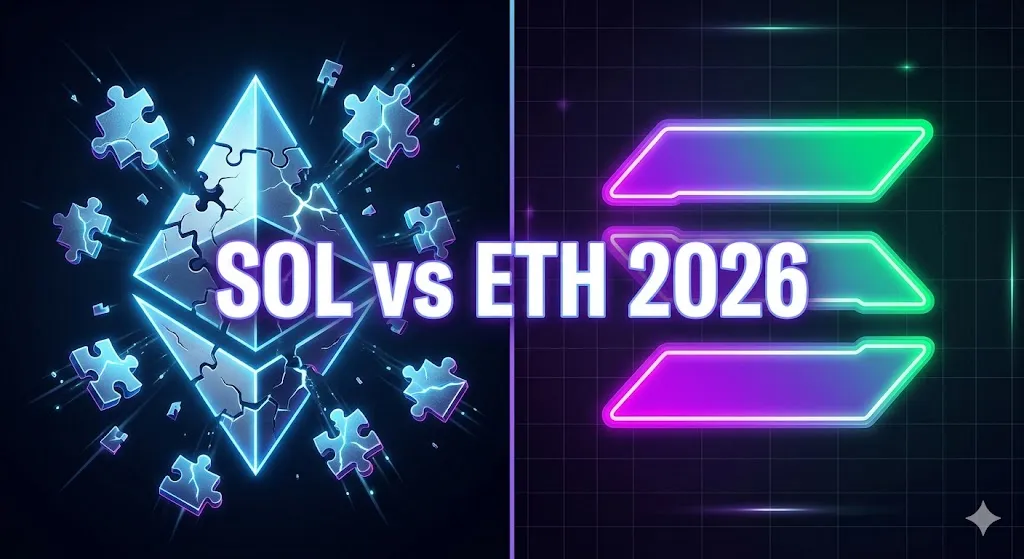
ETH holds institutional capital ($99B TVL), Solana dominates activity (98M users, $1.6T, How Solana Wins.
Speed is the easy answer. Everyone reaches for it. Solana is fast, Ethereum is slow, case closed. But that framing flatters neither chain and explains very little about what is actually shifting between the two ecosystems right now.
The real story is about where developers are choosing to build, where users are actually spending money, and a structural problem inside Ethereum's own scaling strategy that the community is only now beginning to confront honestly.
The Numbers First
By the end of 2025, Solana had pulled off something that looked impossible two years earlier — it became the most-used blockchain by almost every activity metric. Monthly active users hit 98 million, total transactions reached 34 billion, and trading volume crossed $1.6 trillion. Its DEX ecosystem processed $1.5 trillion in volume, up 57% year over year. Seven Solana-based applications each generated over $100 million in revenue.
Ethereum still leads where it matters most for institutional capital. Total value locked climbed to nearly $99 billion. ETF and strategic reserves held over $35 billion in ETH. On-chain real-world asset issuance exceeded $12 billion.
So Ethereum holds the money. Solana holds the activity. That split is not incidental — it is the product of two very different design philosophies playing out in real time.
Where Developers Are Going
The developer migration is the most important signal in this debate, and it cuts both ways.
Ethereum still has the largest absolute developer base. From January to September 2025, Ethereum attracted 16,181 new developers — the highest among all networks. Solana followed with 11,534. In total active developers, Ethereum leads with 31,869, nearly double Solana's 17,708.
But the direction of momentum belongs to Solana. Electric Capital's 2024 developer report found that Solana attracted the most new developers of any chain — 7,625 in a single year, an 83% year-over-year jump. DApp count on Solana expanded roughly 300% annually.
The developers choosing Solana are not just chasing hype. They are choosing a chain where building a trading app, a consumer product, or a high-frequency protocol actually works without the user paying $15 in gas fees on a busy afternoon. That practical reality shapes where builders go, especially first-time founders.
Ethereum's Self-Inflicted Problem
Here is where the Ethereum story gets uncomfortable. The L2 scaling strategy — the rollup-centric roadmap that was supposed to solve Ethereum's throughput problem — has created a different kind of problem that is harder to fix.
A CoinShares research report stated that Ethereum Layer 2 rollups have "unintentionally fragmented liquidity and composability, reducing the overall application, developer, and user experience." A new Ethereum L2 was appearing every 19 days at peak. Each one arrives with its own liquidity pools, its own bridge infrastructure, its own deployment requirements.
With over 50 L2s and more in development, Ethereum became a maze of isolated chains. Users juggle multiple networks, bridge assets, and navigate complex processes to perform basic actions. Capital gets trapped in silos, reducing market efficiency and increasing costs for everyone.
Gnosis co-founder Friederike Ernst put it directly at EthCC 2026: "Ethereum doesn't have a scaling problem. It has a fragmentation problem. Every new L2 that goes live has its own liquidity pool and bridging, creating another isolated walled garden."
Even Vitalik Buterin acknowledged the problem in February 2026, posting that "the original vision of L2 and its role within Ethereum no longer makes sense; we need a new path." That is a significant statement from the person who championed the rollup roadmap.
Solana has no such problem. One chain, one state, unified liquidity. When a user swaps on Jupiter, their experience is not dependent on which L2 their assets happen to be sitting on. That UX simplicity is genuinely valuable and Ethereum has been slow to acknowledge how much it costs them in user retention.
The Revenue Question
One metric that does not get enough attention in this debate is fee revenue — what the chain actually earns from real usage, not just capital parked in it.
Solana's network revenue reached $1.4 billion in 2025, up 48 times in two years, driven by memecoins at $482 billion in volume, launchpads with 11.6 million tokens created, and AI-agent activity at $31 billion in volume.
Some of that activity — memecoins in particular — is speculative noise. But the revenue is real, and it reflects a chain where users are transacting constantly, not just depositing and waiting. Jon Ma, CEO of Artemis, put it plainly: "Solana's metrics highlight explosive user growth, but Ethereum's ecosystem maturity ensures sustained value." That is a fair characterization of the trade-off, but it also understates how much the activity gap matters for protocol revenue and developer incentives.
What Ethereum Is Doing About It
The Ethereum community is not standing still. In late March 2026, developers from Gnosis, Zisk, and the Ethereum Foundation publicly launched the Ethereum Economic Zone — a framework designed to let smart contracts on different rollups execute synchronously within a single transaction without relying on bridges. Early backers include Aave and Centrifuge, with developers calling the EEZ a new era for on-chain applications.
It is the right idea, but it arrives years after the fragmentation problem became obvious, and its success depends on 20+ independent L2s agreeing to adopt a shared standard — a coordination challenge that has no clean precedent in this space.
The Honest Assessment
Ethereum is not dying. Its $55 billion in DeFi TVL, its institutional rails, its battle-tested security track record, and its stablecoin settlement dominance are structural advantages that do not evaporate in a cycle.
But Solana has exposed something real: that a monolithic, high-performance chain with a seamless user experience can capture the majority of on-chain activity even without the legacy liquidity advantage. The gap Solana is exploiting is not technical. It is experiential. And until Ethereum solves its fragmentation problem, that gap will keep costing it the builders and users it needs to close the activity divide.