Russia's New Crypto Bill Could Make Running an Unlicensed Exchange a Criminal Offense
 re****@gmail.com2026-04-19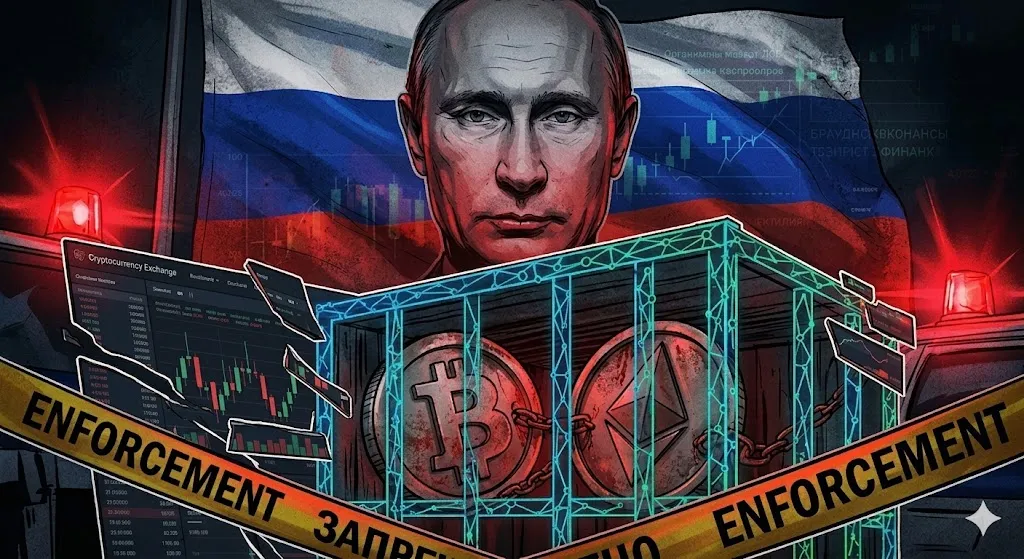
Russia drafts bill criminalizing unlicensed crypto exchanges with fines and jail time, targeting service providers and foreign platforms amid sanctions pressure and capital flight concerns.
The government of Russia has drafted legislation that will make it a criminal offense to provide unregistered commercial crypto services and that this law goes beyond just banning an operation in their country — it will also make the act of providing unregistered commercial crypto services punishable by criminal activities (This is a significant step towards attempting to control the use of cryptocurrencies as the government continues attempt finding a way to regulate these types of transactions). Anyone found guilty of providing unregistered commercial cryptocurrency services will be required to pay fines or risk having their personal assets confiscated, and in extreme instances could face prosecution or jail time for their illegal activities.
Russia has been working in this area for several years. There was initially hope that they would create a legal framework to encourage the use of cryptocurrencies by having a comprehensive law governing commercial transactions made using virtual currencies and developing a comprehensive regulatory framework to regulate these types of transactions.
However, it now appears that rather than providing a legal regime for the orderly and lawful regulation of the use commercial transactions using cryptocurrency, the government intends to use the extensive enforcement powers of the various criminal codes in an attempt to prohibit the use and/or lessen the likelihood of individuals involved in these types of transactions using cryptocurrencies as a means of exchanging value instead of an alternative means to exchange value, such as traditional forms of money and/or other forms of physical financial instruments.
What the Bill Actually Targets
The proposed law focuses more on the services being provided than the individual customer/user being served. For example, an individual holding Bitcoin in their own personal wallet would not fall under the purview of this legislation because of the nature in which they are transferring their funds; however, the legislation is created from the perspective of:
(a.) service providers who have a platform(s) that provides a way for buyers and sellers to connect,
(b.) custodial services that hold customers funds for the customers while they are in possession of those funds, and
(c.) organizations that process crypto payments on behalf of an organization or an individual (i.e., merchant).
In addition to targeting Russian businesses directly, foreign businesses providing services to Russian customers without registering in Russia (similar to how the foreign exchanges operate today) could also be subject to the new law. This is a critical point given the amount of crypto users in Russia (estimates put Russia as either #2 or #3 in the world for total trading volume) and how much of the trading volume is done through exchanges located outside of Russia that will not have a license to do business (and have no obligation to apply for a license). Russia recorded $376 billion in crypto value received between July 2024 and June 2025, surpassing the UK's $273 billion to lead all of Europe.
The proposed legislation does not define how to obtain a license under the new law. As a result, many of the regulatory experts in Moscow are criticizing the proposed legislation for failing to define the steps or process for obtaining a license to provide certain services.
While the proposed legislation will penalize possible infractions for providing services without a license, this will place a negative burden on businesses providing the services unless the proper regulatory framework is in place when the law becomes effective. The bill's specific penalties include fines of up to 300,000 rubles, compulsory labor, or up to four years' imprisonment for a basic offense.
Why Now
Russia's view on cryptocurrencies is influenced by three overlapping factors: preventing capital flight, finding a way to circumvent Western sanctions, and having legitimate concerns over the use of cryptocurrencies for money laundering or other illicit activities. All three factors have become accentuated since 2022 due to the fact that many segments of the global financial system were cut off from Russia due to sanctions, and crypto has become some of the easiest ways to transact across borders. However, this also makes it easier for individuals to move money that the Russian government may not be able to monitor.
The intention behind this bill is likely to use the legalization and registration of crypto services as a way for the government to track crypto transactions and impose taxes on the activity, while at the same time preventing illegal exchanges from operating without the knowledge of the government.
Russia also legalized cryptocurrency mining in 2021 and has been actively working towards building an infrastructure for domestic digital assets, including the Digital Ruble project. The Digital Ruble's retail rollout was postponed to September 2026, though federal government departments were cleared to begin using it from January 2026. Ledger Insights Criminalizing unlicensed exchanges is another example of the same strategy — instead of trying to eliminate cryptocurrencies, the Russian government is attempting to take steps to control the rails that cryptocurrencies can operate on.
What This Means for Exchanges
International exchanges that cater to Russian customers must now face a tough decision: either conform to Russian registration requirements or discontinue their services to Russian users entirely. Neither option presents a straightforward solution.
By registering, exchanges are now subject to Russian Financial Oversight, which can result in a number of complications due to the nature of how sanctions operate. In addition, being registered in Russia will carry at least some level of reputational risk and/or legal risk in different geographic areas. While many major Western exchanges already have reduced or restricted the ability for Russian customers to trade due to pressure from sanctions and restrictions, there are still many smaller offshore exchanges and peer-to-peer platforms that are available to support Russian traders and customers.
It is also much more difficult to regulate peer-to-peer trading without targeting individual users, and there does not appear to be a mechanism within the bill for doing so. The absence of a robust enforcement mechanism targeting individual user trading activity may be the ultimate limitation of the law. Broader crypto rules are expected from 2026, with the criminal provisions not taking effect until 2027.
The Bigger Picture
Russia isn't alone in moving toward tighter crypto regulation, but the criminal enforcement angle is sharper than what most countries have adopted. The European Union's MiCA framework creates compliance requirements with fines for violations. European Securities and Markets Authority The U.S. has pursued enforcement through securities law and anti-money laundering regulations. Russia is reaching for the criminal code.
Whether the bill passes in its current form is another question. The State Duma has advanced plenty of crypto-related legislation that stalled or got revised significantly before becoming law. The registration framework still needs to be built out, and the practical challenge of enforcing criminal penalties against foreign platforms operating on decentralized infrastructure is real.
What the bill signals, clearly, is that Russia's tolerance for the informal crypto economy — the gray zone of unregistered services and offshore exchanges serving domestic users — is running out. The question is whether the regulatory infrastructure can be built fast enough to give businesses something to actually comply with, or whether the law ends up creating criminal liability in a vacuum.