Smart Contract Admin Keys: What Every Crypto Investor Must Know
 yo****@gmail.com2026-04-23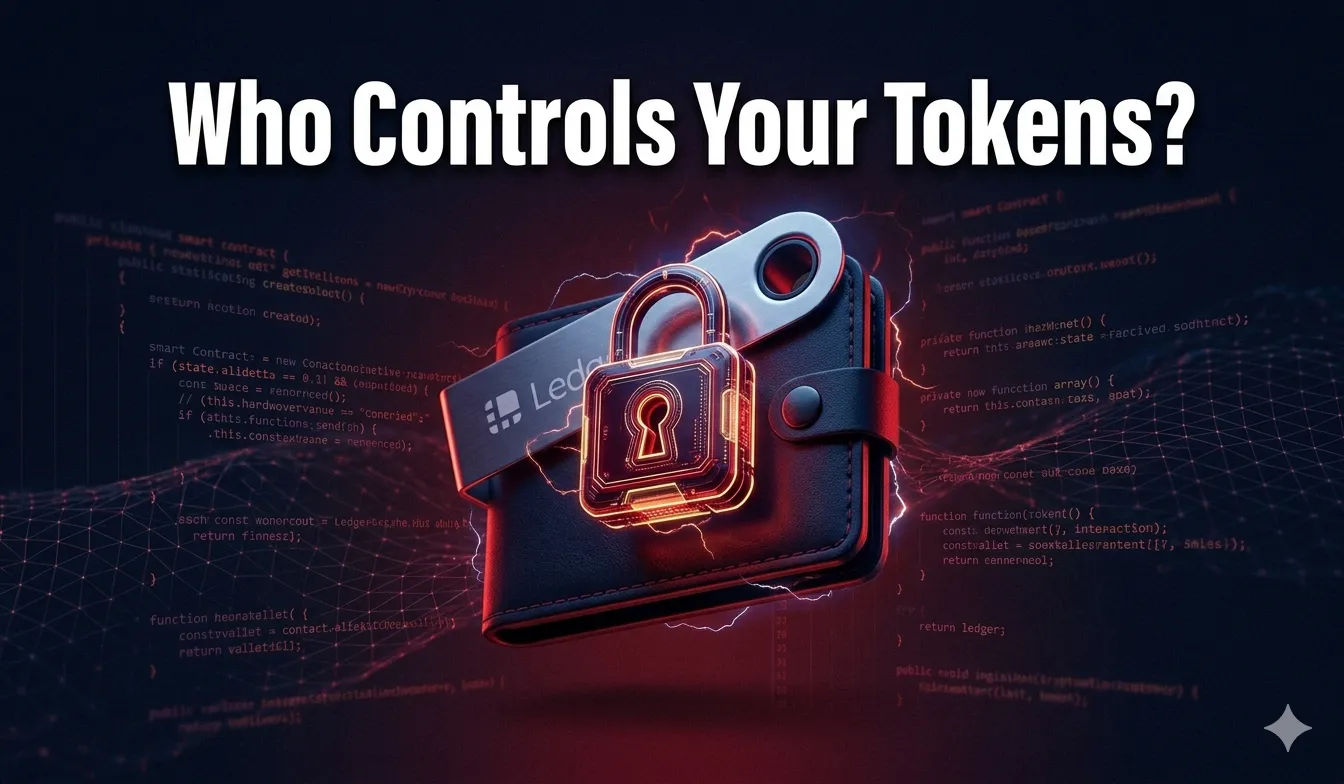
In September 2025, WLFI froze Justin Sun's $100M in tokens using a hidden smart contract function. Here is what admin keys are and how to check if your token has one.
In September 2025, Justin Sun, the founder of Tron and single largest investor in World Liberty Financial, woke up to find over $100 million of his tokens completely frozen. He had not done anything illegal. No court had ordered the freeze. No regulator had intervened. A function buried inside WLFI's smart contract, one that was never disclosed to any investor, was activated unilaterally by the project team. His wallet was blacklisted. The tokens were locked. And there was nothing he could do about it.
In April 2026, Sun went public with the full story, describing the function as "a trap door marketed as an open door" and calling it a fundamental violation of blockchain principles. He is right. But the more important question for every crypto investor is not what happened to Justin Sun. It is whether the token sitting in your own wallet has the same function written into its code.
Many of them do.
What a Smart Contract Actually Is
Before understanding admin keys, you need to understand what a smart contract is, because the name is slightly misleading. A smart contract is not a legal document. It is a piece of code deployed permanently on a blockchain. It defines the rules of a token: how many exist, how they can be transferred, who can send them, who can receive them, and what conditions trigger what actions.
Once deployed, a smart contract cannot be changed or deleted. That permanence is precisely what makes blockchain valuable. Nobody can reach in and quietly rewrite the rules after the fact.
Except, as it turns out, sometimes they can.
What an Admin Key Is
An admin key, sometimes called an owner key or a privileged address, is a special permission written into a smart contract that grants specific powers to whoever controls a designated wallet address. The person who deploys the contract typically holds this key at launch, and it can grant the ability to do things that regular token holders cannot.
Common admin key functions include the ability to mint new tokens, effectively creating supply out of thin air. The ability to pause all token transfers, freezing the entire market for the asset. The ability to change the transaction fee on transfers, sometimes to 100%, which means every transfer sends the full amount to the contract owner. The ability to upgrade the contract itself, changing the rules of the token entirely. And the function at the centre of the WLFI story: the ability to blacklist specific wallet addresses, preventing them from sending or receiving tokens.
None of these functions are inherently malicious. Stablecoins like USDC use blacklist functions to comply with law enforcement requests and freeze wallets tied to crime. Upgradeable contracts allow development teams to fix bugs without redeploying an entirely new token. Pause functions exist for genuine emergencies. The problem is not the existence of these functions. The problem is when they exist without being disclosed, without being governed by transparent community processes, and without any checks on how or when they can be used.
The WLFI Blacklist Was a Disclosure Failure
The specific function used to freeze Justin Sun's wallet was called guardianSetBlacklistStatus. It was documented on-chain by Wu Blockchain after the freeze, meaning anyone who looked at the contract code could technically have found it. But it was not mentioned in any investor documentation, not included in any public disclosure, and not put to a governance vote before it was embedded in the contract. It was added one week before the token became transferable in September 2025.
WLFI sold itself as a decentralized finance platform designed to promote financial freedom and remove intermediaries. The existence of a unilateral wallet freeze function, controlled by a single team, with no notice requirement and no appeal process, is the exact opposite of that description. The project raised over $550 million from investors who believed they were buying into a permissionless system. The function was there from the beginning. It simply was not advertised.
This is the disclosure failure that Sun's April 2026 statement calls out directly. The problem was not that WLFI had an admin key. The problem is that investors were never told it existed.
Why This Is More Common Than People Think
WLFI is not an unusual case. Research into smart contract centralization defects found that the vast majority of audited contracts contain at least one centralization vulnerability, with more than 80% of reported defects arising from functions controlled by a single private key address. Access control vulnerabilities were ranked the number one category of smart contract risk by OWASP's 2026 Smart Contract Top 10, accounting for $953.2 million in documented losses in a single year.
The Squid Game token, one of the most notorious early examples, concealed a backdoor that allowed only the developer to sell tokens. Every retail investor who bought in could not exit. The developer sold. The price collapsed to zero. The backdoor was in the code the whole time.
In 2021, the Poly Network hack resulted in over $600 million in losses when attackers gained access to admin privileges and used them to modify transaction records. Admin role leakage, a specific type of centralization defect where admin permissions are improperly assigned or exposed, caused $48 million in losses across five DeFi projects in just the first half of 2025 alone.
The pattern is consistent. The function exists. It is either not disclosed or buried in technical documentation most investors never read. And when it is used, whether by an attacker who gained access or by the project team itself, token holders have no recourse.
The Difference Between Legitimate and Dangerous Admin Keys
Not every admin key is a red flag. The distinction comes down to three things: disclosure, governance, and limits.
Legitimate use of admin keys looks like this. The function is clearly documented in the project's whitepaper and technical documentation. It can only be activated through a multi-signature process requiring several independent keyholders to sign off, not a single address controlled by one team.
It is subject to a timelock, meaning there is a mandatory delay between a change being proposed and it taking effect, giving token holders time to exit if they disagree. Community governance has approved its existence and its conditions of use. CertiK and other audit firms specifically flag and rate these functions as part of their security assessments.
Dangerous admin keys look like this. The function is not mentioned in any public documentation. It is controlled by a single private key held by the founding team with no multi-sig requirement. There is no timelock, meaning it can be activated instantly. Governance votes, if they happen at all, are conducted without full information being available to voters. This is precisely what Sun described in his April 2026 statement: "Key information was withheld from voters, meaningful participation was restricted, and the outcomes were predetermined."
How to Check a Token Before You Invest
The good news is that smart contract code is public on the blockchain. You do not need to be a developer to do a basic check, because several free tools have been built specifically to surface these risks for non-technical users.
Token Sniffer allows you to paste a contract address and get an automatic scan identifying suspicious functions including blacklist capability, pause functions, hidden mint functions, and proxy upgrade risks. De.Fi Scanner performs a similar analysis and specifically checks for transfer-blocking functionality, fee manipulation, and owner privilege flags. CoinGecko and CoinMarketCap both increasingly display audit information and centralization warnings on token pages. For any token you are seriously considering, searching for its contract address on Etherscan or BscScan and looking for audit reports from firms like CertiK, Hacken, or Trail of Bits will tell you whether the code has been independently reviewed and what risks were flagged.
None of these steps take more than a few minutes. They will not catch everything, but they will surface the most obvious centralization risks before you commit capital.
What the WLFI Case Changed
Before the Justin Sun blacklist became public knowledge in September 2025, most retail investors did not think about admin key disclosure. It was a developer conversation, buried in audit reports, discussed at security conferences. The public escalation in April 2026 made it unavoidable.
A project that raised over half a billion dollars, backed by one of the most prominent political families in the United States, with a publicly stated mission of financial freedom and decentralization, secretly embedded a function that allowed it to freeze any investor's tokens without notice, cause, or recourse. Its single largest investor, a billionaire with legal resources and global reach, has been unable to access over $100 million of his own assets for seven months and counting.
If it can happen to him, it can happen to anyone.
The blockchain is transparent. The code is public. The tools to check it are free. The only question is whether investors choose to look.