Will Stablecoins Kill Your Bank Account? Moody's Says Not Yet — But Watch the Next Five Years
 el****@gmail.com2026-04-23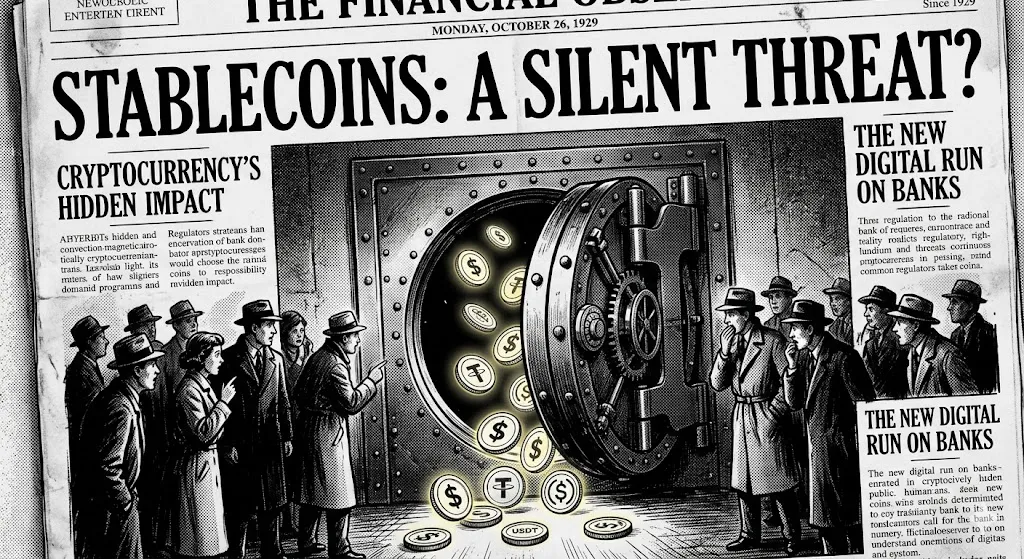
Moody's says stablecoins pose no immediate bank threat, but Jefferies warns of a 3–5% deposit drain over five years as the market eyes $1 trillion.
Banks are not in immediate danger from stablecoins. That is the short version of what Abhi Srivastava, associate vice president at Moody's Investors Service Digital Economy Group, told reporters recently. The longer version is more interesting — and considerably more uncomfortable for anyone running a traditional bank.
Stablecoin market cap crossed $300 billion at the end of last year, up 49% from the year before. Settlement volume hit roughly $9 trillion in 2025, about 87% more than in 2024. Those are not small numbers. And yet Srivastava's position is that the near-term threat to the banking system is limited — mostly because U.S. regulators have, at least for now, banned stablecoins from paying yield. No yield means less incentive for ordinary depositors to move money out of savings accounts and into digital dollars. That protection buys banks some time. The question is whether they use it.
The Yield Ban Is Doing Heavy Lifting
The GENIUS Act prohibits passive stablecoin holders from receiving yield on their balances, and this prohibition is the predominant factor for stablecoins not triggering a deposit run. If there is no reason to be incentivized to withdraw your USDC to create an emergency fund outside of the high-yield savings account you now have, you are likely to leave it there, as banks understand. However, that could change.
Earlier in the year, Bank of America president Brian Moynihan cautioned that as high-yield savings accounts were able to generate interest at some point in the future, as many as $6 trillion in deposits could potentially move toward stablecoin-affiliated products. Jefferies completed a similar analysis, finding that stablecoin adoption could ultimately cause a 3%-5% reduction in core deposits at banks over the next five years resulting in a 3% decrease in average bank earnings due to the cost of funding. However, neither Bank of America nor Jefferies anticipate that this will cause any major negative ramifications for banks, yet both banks acknowledge that the longer this progresses, the harder it becomes for banks mathematically.
What Stablecoins Are Actually Being Used For
Moody's analysis gets more detailed. Srivastava didn't say stablecoins are not important; he said their current deployment isn't impacting retail banks. Right now the activity is actually occurring at the institutional level. Banks are utilizing treasury issued backed stablecoins, such as Citi and SocGen, to facilitate moving intraday liquidity between investment funds, credit pools and trading venues. Moody's cites JPMorgan's JPM Coin as an example of how deposit tokens can be layered on top of current banking systems and facilitate programmable payments without disrupting the underlying core banking system. JPM Coin and deposit tokens in general match the novel and distinctive properties of stablecoins, most notably the ability to conduct peer-to-peer transactions with programmability.
This is a drastically different picture than the doomsday retail scenario. Moving money between institutional counterparties at 3 AM on a Sunday via stablecoins is not at all the same thing as consumers withdrawing funds from a Chase account. Moody's view on both fiat-backed stablecoins and tokenized deposits is one of them evolving into what Moody's refers to as "digital cash," or the plumbing layer of our financial system versus being an outright replacement to our current systems (at least not yet).
The Legislation Problem Nobody Has Solved
The reason the immediate threat remains low is that Congress is still working on its job. The CLARITY Act a comprehensive bill on regulating cryptocurrency markets, including determining which agencies regulate which suppliers of stablecoins — remains stalled in the Senate Banking Committee. Coinbase has worked with a group of other crypto companies to oppose previous versions of the bill for two reasons: no legal protections for open-source software developers; and imposing a ban on yield-bearing tokens. The bill continues to be negotiated between the parties over a period of months with no end in sight.
The effect of this stalemate is that regulatory uncertainty extends longer than either side desires. Banks are not subject to regulatory competition from crypto companies while they continue to be held up in regulatory limbo. Crypto companies are unable to develop the products that users clearly want to use in the market. Individuals who access cheaper/faster cross-border payments via their mobile devices remain in a waiting pattern. The current status of these two sides is unsustainable.
Risks That Are Not Getting Enough Attention
Moody's will not signal the last call for banking in danger. They write: "There are a number of possible things we can imagine going wrong with the stablecoin system's growth": Smart contract bugs; Oracle failures; Cyber threats to custodian entities; and System fragmentation across competing blockchain networks.
These could occur in larger, more valuable markets; therefore the overall risk of failure is much higher for each outcome as the level of transaction activity increases on stablecoin infrastructure going forward.
The March 2026 release of a formal stablecoin rating methodology from Moody's is also important: this methodology only applies to fully collateralized stablecoins that meet a number of detailed requirements, including having reserves that are separate from the issuer's balance sheet. Algorithmic stablecoins, which have seen tremendous failures since their inception in 2022, do not have a rating methodology and thus are not included as options for investors based on Moody's methodology.
Therefore, the exclusion of algorithmic stablecoins suggests they cannot be reliably rated or measured in risk by Moody's; therefore Moody's does not believe they are worthy instruments to include as investments.
The Five-Year Question
The analysts who argue that stablecoins "do not represent an immediate threat" have yet to say that stablecoins pose no risk over the long run for banks either. According to Jefferies research, it would not be surprising if the market for stablecoins approximates $800 billion to $1.15 trillion within the next five years; at this level, whether or not yield restrictions are put in place, it will be clear that traditional deposit funding will face greatly increased competition.
Banks that have used these few years of regulatory uncertainty to build their own tokenized payment products, such as JPMorgan has, should ultimately be at an advantage compared to those banks that assumed that the freeze in obtaining governmental approval for stablecoin-based products would last indefinitely.
The comments made by Srivastava were very reasonable and measured (as you would expect from an analyst at Moody's). If you read between the lines of his statements, they are not as positive as they appear from the headlines of his firm's report. He uses the term "near-term" to specify a timeframe. It is not a permanent condition. The stablecoin market is growing rapidly; institutional participation in the stablecoin market is now significant; and the laws that protect the safety of retail deposits could easily be changed. Therefore, banks have a timeframe. The question that needs to be asked honestly is, have banks recognized this period of time as a timeframe?