US Lawmaker Proposes AI Dividend as Fears of Job Displacement Grow
 Natalia Ivanov2026-04-23
NY Assemblyman Alex Bores proposes an "AI Dividend" to counter job displacement. The plan uses tax reforms to fund citizen subsidies and incentivize hiring humans over AI.
An assembly member in New York state assembly and a congressional candidate has come up with a proposal that would train American workers to face an economic disruption brought about by artificial intelligence. The proposal focuses on what it calls an AI dividend, whereby the direct payments would be given to citizens with a reevaluation of tax policy to deter too much replacement of human labour with automated systems.
The proposal is timed as worries regarding AI-led job displacement are increasingly taking center stage in policy-making, corporate strategy, and economic projections.
The AI Dividend Proposal Explained
New York lawmaker Alex Bores proposed it in a post on X, stating the concept as an outline to train the United States to the so-called AI economy.
The AI dividend plan consists of two components, at its core. The former is a subsidy regime to US citizens that would be like a common economic good of artificial intelligence-motivated productivity improvements. The second one is an instrument of tax reform that will motivate businesses to focus on human hiring, instead of completely substituting work with AI systems.
The proposal is framed as an initiative instead of a safety net, which is responsive, and seeks to spread the benefits of automation more widely throughout the society.
Rising Concerns Over AI Driven Job Losses
The concept of an AI dividend is being developed in the context of an increasing concern about the threat to the labor market. The development of generative AI, automation, and machine learning systems has already started transforming the business spheres of customer service, software development, content production, and administrative work.
According to recent assessment by Goldman Sachs, AI adoption has already led to substantial changes in the labor markets, which estimates that about 16,000 jobs each month have already been impacted in the last year. Although the precise meaning of loss in this context is uncertain, the report indicates larger issues that AI is hastening the structural shifts in employment patterns.
These changes have fuelled a debate on the way governments ought to react to technological displacement.
How the AI Dividend Would Work
Although the proposal is still in theory, the framework proposes a model in which productivity gains achieved through AI are re-distributed, in part, to the population. This would serve the same purpose in spirit as resource based dividends, in which economic gains of a dominant technology/sector are distributed to the citizens.
Within the proposed framework, the money would be financed through tax reforms that would modify incentives of such businesses that utilize AI on a large scale. The policy would also seek to balance between the efficiency and job saving by not viewing automation as a cost saving measure but as a way of saving jobs.
It is aimed not to limit the development of AI, but to make sure that its economic benefits are not concentrated in the hands of corporations and owners of technologies.
Balancing Automation and Employment
One of the most critical issues in the proposal is the tradeoffs between innovation and protection of labor. Artificial intelligence is taking over business operations, as it saves cost and enhances productivity.
Nonetheless, policy makers such as Bores believe that unless there is intervention, the results of these efficiency gains might be unevenly distributed in the economic arena as wealth created by automation is not redistributed widely.
The concept of AI dividend tries to overcome this by relating technological advancement to social compensation systems, in effect, making AI induced productivity a common economic resource.
Chart Concept of AI Driven Labor Shift
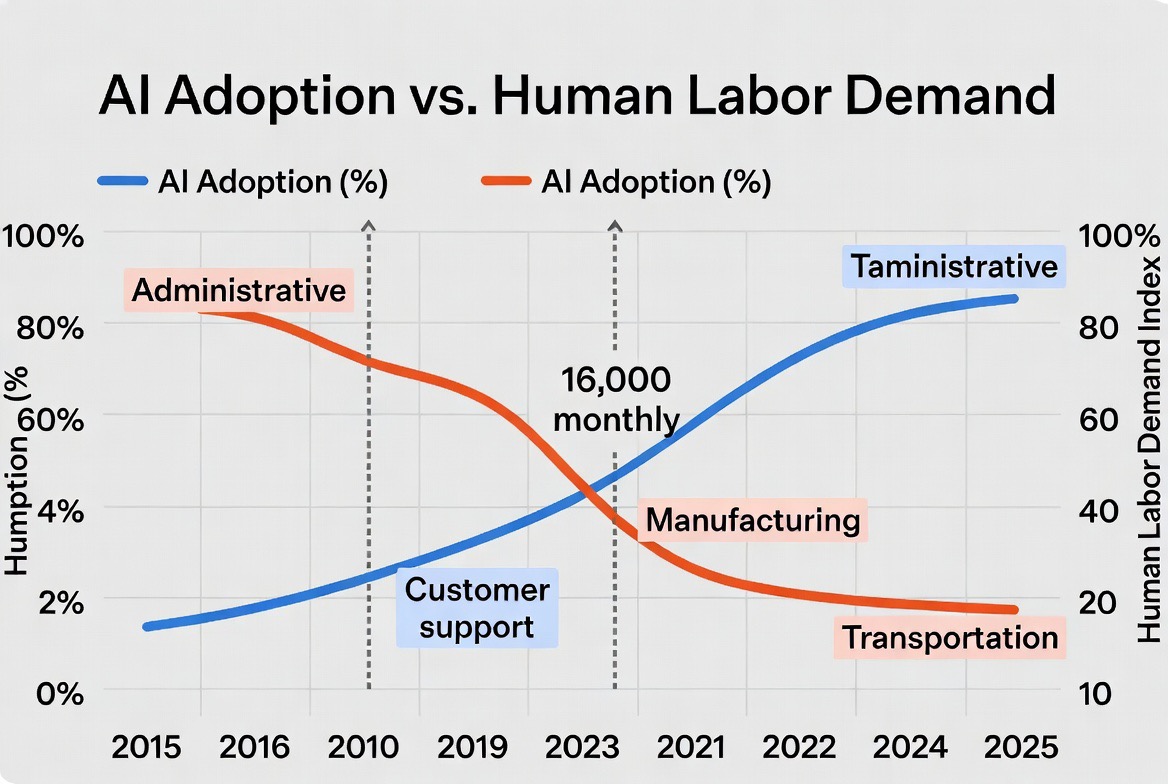
AI adoption surges as human labor demand declines — especially in admin & customer support (~16k jobs/month impacted).
Broader Economic Debate on AI Redistribution
The proposal is representative of a more general debate on a global scale regarding the way societies ought to react to automation. The same has been discussed using the models of universal basic income, robot taxation, and productivity sharing.
Proponents of redistribution policies believe that AI is a general purpose technology like electricity or internet, and thus its advantages are to be widely distributed. According to critics, innovation and competitiveness would be slackened by heavy taxation or redistribution.
The AI dividend proposal lies in the middle of these two views in that it tries to save innovation but at the same time tries to add a mechanism of economic balance.
Political and Policy Implications
In case such plans as the AI dividend become popular, they might transform the ways governments consider taxation, the labor market, and the digital infrastructure. The policymakers would strive to construct mechanisms that will automatically even out the benefits of technological advancements instead of responding to job losses once they have occurred.
This would be a big change in the formulation of economic policies, particularly in the United States where labor markets were historically influenced by the dynamics of the private sector, as opposed to direct redistribution of the gains of automation.
Chart Concept of AI Dividend Flow Model
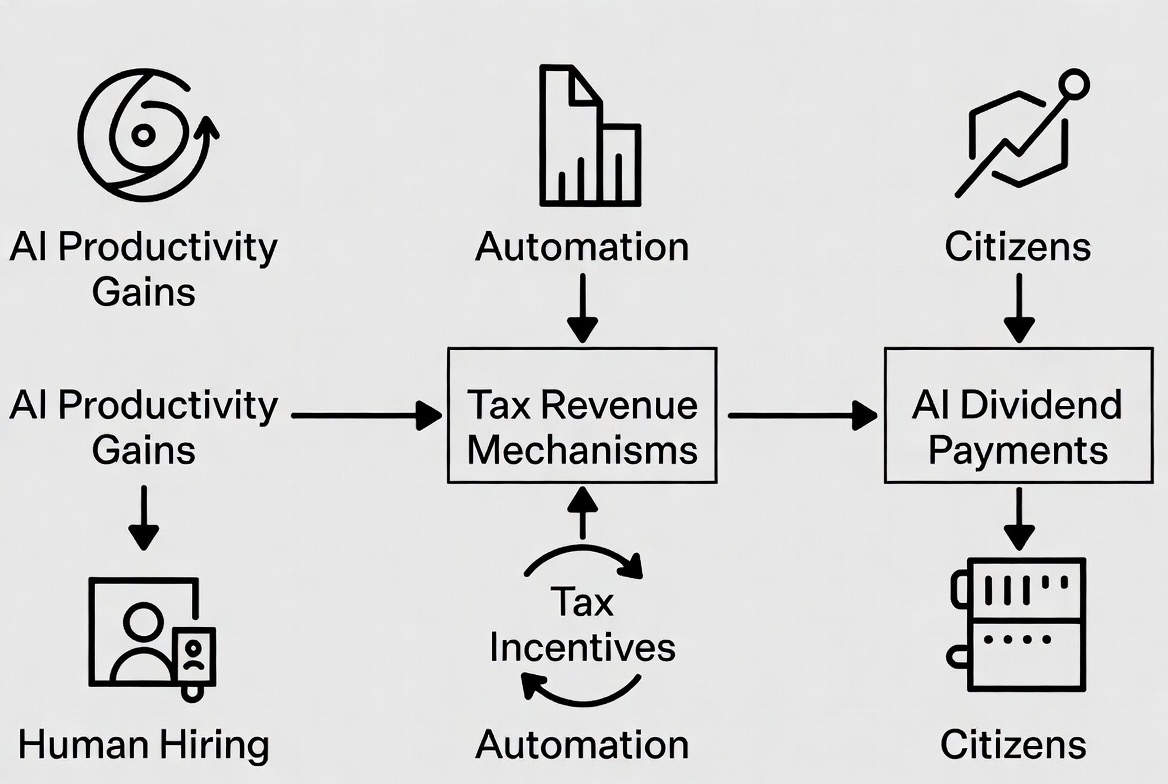
AI productivity gains → Tax revenue → AI Dividend payments to citizens, with tax incentives creating a feedback loop between automation and human hiring.
Challenges in Implementation
The AI dividend proposal, although ambitious, has a number of practical problems. It is still not easy to define what is meant by AI driven job displacement, particularly since automation does not necessarily create jobs but often transforms them.
Moreover, it might be hard to strike a balance on designing a fair tax system that promotes human employment but does not deter innovation. Another question is how the program would be financed on such a scale and the distribution of benefits between income groups.
These issues indicate that, though the concept is receiving some acquaintances, a lot of policy formulation would be necessary before its execution.
Conclusion
The AI dividend proposal presented by Alex Bores is indicative of the increasing worry that AI may fundamentally restructure the labor market more rapidly than the traditional economic systems can keep pace.
As estimates suggest 16,000 jobs per month will be impacted by AI adoption, policymakers are starting to consider ways to ensure technological advances can be converted into a shared economic good.
Although still in its nascent phases, the suggestion points to a more fundamental change in economic thought: no longer responding to job disruption when it happens but creating systems that capture the benefits of automation as they arise.