Uzbekistan Creates State-Backed Crypto Mining Zone with Tax Breaks
 ra****@gmail.com2026-05-06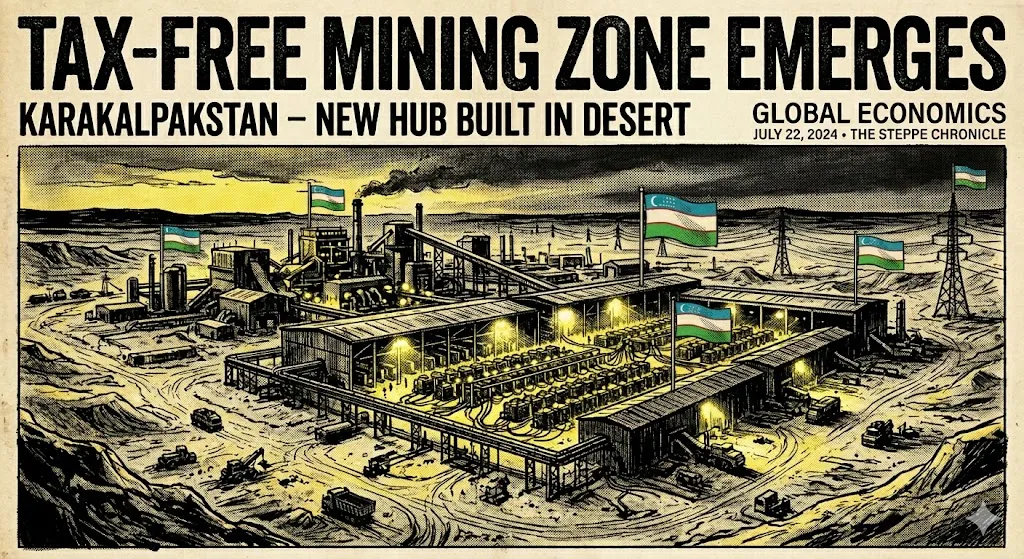
Uzbekistan's Besqala Mining Valley offers a 10-year tax holiday and flexible energy rules in Karakalpakstan, reversing a 2023 solar-only mandate to attract large-scale global crypto miners.
Uzbekistan created a specialized area for cryptocurrency mining — specifically aimed at the poorest area of the country. In return for being granted special status by the government, approved companies will receive almost 10 years of tax relief as long as they keep all revenues from mining in Uzbekistan's banking system. This new resolution was signed by President Islam Karimov on April 17, 2020 and went into effect on April 20, 2020. The
Besqala Mining Valley is located in an autonomous region of Karakalpakistan in northwest Uzbekistan.
This is a major change in the way that Uzbekistan treats the mining of digital assets; it also means that many of the restrictions placed on miners by the government less than 3 years ago will now be lifted.
What the Decree Actually Creates
The Besqala Mining Valley is located within a special economic zone governed by the Karakalpakstan Council of Ministers, which oversees its own administration. Legitimate registered entities may apply for a resident's status to carry out Bitcoin and other proof-of-work cryptocurrency mining, so long as they sell mined assets on either domestic or globally accessible (using direct contracts) exchanges, including mined assets on banking apps. For additional liquidity sources, miners can also trade mined assets for other more liquid crypto assets.
The government has put in place stringent financial controls, whereby all sales of cryptos, regardless of being sold either domestically (i.e., to Kazlasting Mrlat Zone residents) or abroad (i.e. through direct contracts), have to be recorded as sourced from within the country (i.e. in compliance with Central Bank of Uzbekistan directives). Therefore, while the government is allowing greater access to international markets by allowing cryptos to be sold overseas, it is also ensuring that all proceeds of sales are remitted to Uzbekistan.
Regarding taxes, resident companies are exempt from corporate income tax and property tax until January 1, 2035. Additionally, resident companies pay a monthly fee equal to 1% of mining revenue, instead of compliance with standard forms of taxation. The present government has told officials to submit proposed amendments to the taxation code within the next two months, indicating that general legal frameworks regarding cryptocurrency taxation have yet to be finalized in Uzbekistan.
A Reversal of Earlier Energy Restrictions
One of the most significant practical changes in the new decree involves energy. In 2023, Uzbekistan's National Agency for Perspective Projects required licensed crypto miners to use only solar power for their operations. That restriction is now gone.
Under the Besqala framework, zone residents can draw from renewable energy, hydrogen, and the national grid. Grid electricity comes at higher tariff rates than renewables, but the option now exists. For large-scale operations that need guaranteed uptime regardless of solar conditions, grid access is a necessity. Removing the solar-only requirement makes Uzbekistan's offer substantially more practical for serious operators.
The Karakalpakstan Context
The location of the mining zone in Karakalpakstan was chosen intentionally for its economic significance beyond cryptocurrency. The UN Development Programme's report on Karakalpakstan, released in 2025, concluded that it contained significant poverty and limited industrial development, making it a priority for targeted investment incentives — a region specifically targeted for economic revival.
The Besqala Mining Valley will not be the last special zone created in Karakalpakstan. The government of Uzbekistan announced an additional tax-free zone for AI and data center projects was opened in Karakalpakstan in early 2025 — any foreign company investing a minimum of $100 million can receive an exemption from taxes and duties until 2040, with Uzbekistan planning to attract over $1 billion in foreign investment from that project by 2030.
The Besqala Mining Valley establishes a playbook for other crypto mining zones to replicate, allowing for an economically favourable regulatory environment, attracting more capital, and creating economic activities in a region that does not have many other forms of economic activity.
Key Terms of the Besqala Mining Valley
What This Signals Regionally
While other jurisdictions tighten restrictions, Uzbekistan is positioning itself as a crypto mining haven. Uzbekistan's competitive advantages — including a lengthy tax holiday, a flexible energy policy, access to foreign markets, and an operating structure that is supervised by the government — set it apart from most of its Central Asian counterparts.
In exchange for repatriating all proceeds back into Uzbekistan's banking system, miners can benefit from a clear legal environment and favorable economics; conversely, the government will benefit from improved visibility into capital flows and will ensure that foreign exchange will remain within Uzbekistan's financial systems. For miners who are willing to comply with the law and are looking for an affordable, regulated environment, this trade-off is reasonable. The amount of foreign investment generated within the zone will ultimately be determined by how quickly the necessary infrastructure is created — the government has committed to grid modernization targeting 1GW capacity to support operations. Until then, there will be no ability to achieve what has been promised on paper through regulation.