

Crypto staking has gained significant popularity as a way for cryptocurrency holders to earn passive income on their investments. Instead of just holding onto your digital assets, staking allows you to actively participate in the network's security and validation process. By locking up your tokens, you contribute to the blockchain's stability and, in turn, receive rewards. This process is fundamental to blockchains that utilise the Proof of Stake (PoS) consensus mechanism.
To grasp how staking works, it's helpful to understand the underlying Proof of Stake (PoS) consensus mechanism. Blockchains need a way to verify and secure transactions without relying on a central authority. PoS is one such method, offering an alternative to the Proof of
In a PoS system, instead of miners solving complex cryptographic puzzles to validate transactions (as in PoW), validators are selected to create new blocks based on the amount of cryptocurrency they have staked. The more crypto a validator stakes, the higher the probability of them being chosen to verify and process a new block. This mechanism incentivises validators to act honestly, as they risk losing their staked crypto if they attempt to validate fraudulent transactions.
How POS and POW work? Comparison of POS and POW(Bitcoin)
The process of crypto staking typically involves two key roles: validators and delegators.
Validators: These are node operators who are responsible for verifying transactions and creating new blocks on the blockchain. To become a validator, a user usually needs to stake a significant amount of the network's native cryptocurrency as collateral. This staked amount acts as a security deposit, ensuring the validator's integrity. Validators earn rewards in the form of newly created cryptocurrency and transaction fees for their services.
Delegators: Not everyone has the technical expertise or the substantial amount of crypto required to become a validator. This is where delegators come in. Delegators are users who lock up a smaller amount of their crypto and delegate it to a validator. By entrusting their stake to a validator, delegators contribute to the validator's overall stake, increasing their chances of being selected to validate blocks. In return, delegators earn a portion of the rewards that the validator receives. This allows a wider range of users to participate in staking and earn passive income.
If you're interested in participating in crypto staking, the process generally involves the following steps:
Choose a Cryptocurrency to Stake: Not all cryptocurrencies use the PoS mechanism and offer staking rewards. You'll need to select a cryptocurrency that supports staking. Popular options include Ethereum (ETH), Solana (SOL), Cardano (ADA), and many others.
Acquire the Necessary Cryptocurrency: You will need to own the cryptocurrency you wish to stake. This can typically be done by purchasing it on a cryptocurrency exchange like LBank.
Select a Staking Method: You have a few options for staking:
Native Staking (Running your own validator node): This requires more technical knowledge and a larger stake but offers the most control.
Staking Pools: Join a staking pool where multiple users pool their crypto to increase the chances of earning rewards. Rewards are then distributed proportionally.
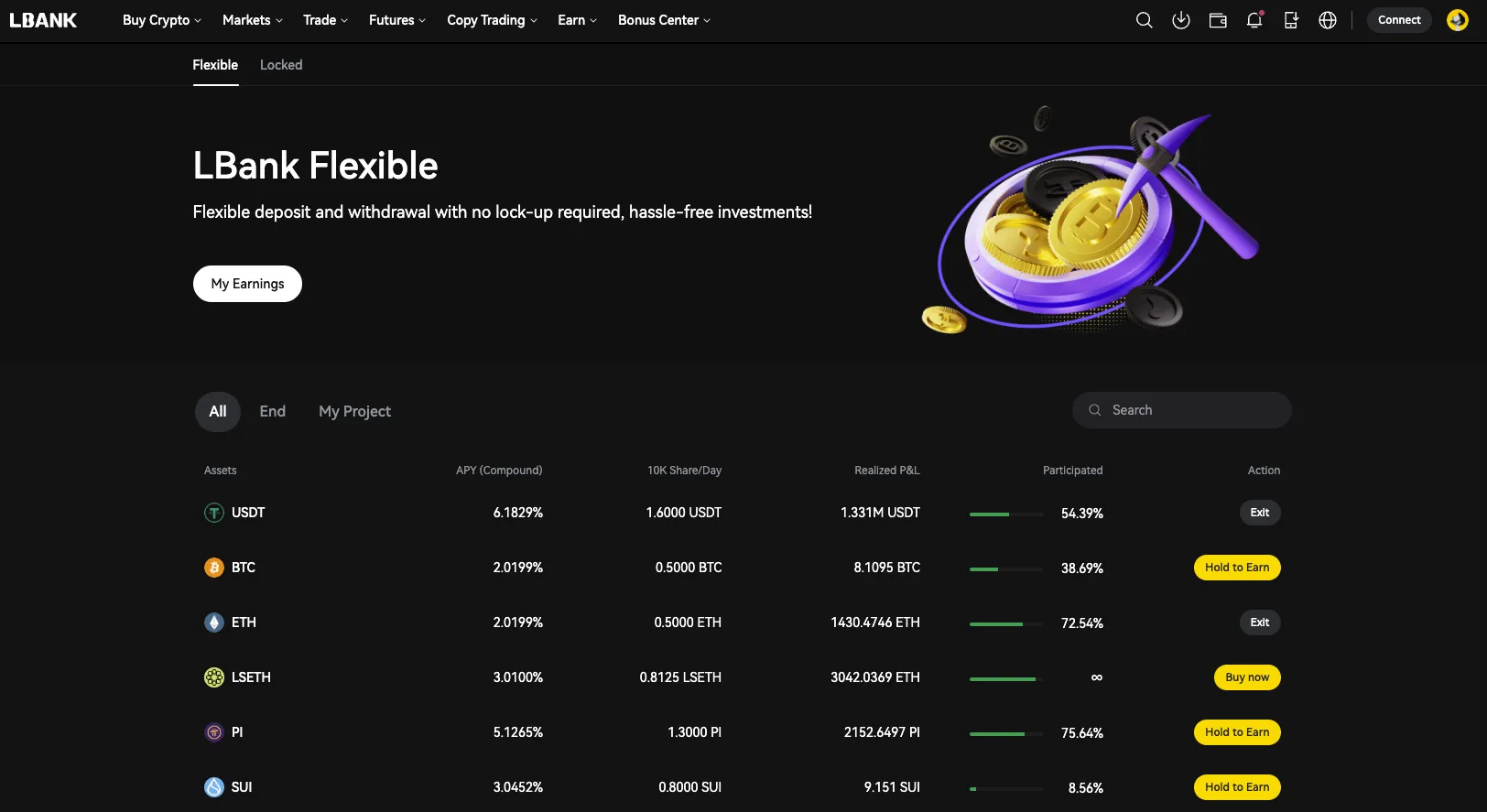
Staking through an Exchange (like LBank): Many cryptocurrency exchanges offer simplified staking services. This is often the easiest option for beginners as the exchange handles the technical complexities. On platforms like LBank, you can often find flexible staking options where your assets are not frozen, allowing you to trade or withdraw at any time. You would typically navigate to the 'Earn' or 'Flexible' staking section on the platform.
Screenshot of Flexible Earn page of LBank.com 2025/03
Stake Your Crypto: Follow the instructions provided by your chosen staking method or platform to lock up your cryptocurrency.
Earn Rewards: Once your crypto is staked, you will begin to accrue rewards based on the network's rules and the amount you have staked. Reward frequencies and rates can vary depending on the cryptocurrency and the staking method. On LBank Flexible Staking, revenue is usually settled daily based on snapshots of your holdings.
Participating in crypto staking offers several potential benefits:
Passive Income: Earn rewards on your cryptocurrency holdings without actively trading.
Contributing to Network Security: By staking, you help to secure the blockchain network and ensure its stability.
Lower Barrier to Entry Compared to Mining: Staking generally requires less technical expertise and lower upfront costs compared to cryptocurrency mining.
Potential for Compound Interest: Staking rewards can often be automatically added to your staked amount, leading to compound interest over time.
Supporting Your Favourite Blockchains: Staking allows you to actively support the blockchains you believe in.
While staking offers attractive benefits, it's important to be aware of the potential risks involved:
Price Volatility: The value of your staked cryptocurrency can fluctuate, and if the price drops significantly, your overall returns may be diminished.
Lock-up Periods: Some staking methods require you to lock your crypto for a specific period. During this time, you may not be able to access or trade your assets.
Unstaking Periods: When you decide to unstake your crypto, there may be a waiting period before your assets become fully liquid again.
Validator or Platform Risk: If you are delegating your stake to a validator or using a staking platform, there's a risk of the validator performing poorly or the platform facing security breaches. It's crucial to choose reputable and reliable platforms like LBank.
Slashing: In some PoS networks, if a validator acts maliciously or improperly, a portion of their staked crypto (and the crypto of their delegators) can be "slashed" as a penalty.
Minimum Staking Requirements: Some cryptocurrencies may have minimum amounts required to participate in staking.
Crypto staking presents an exciting opportunity to earn rewards on your cryptocurrency holdings while contributing to the security and operation of blockchain networks utilising the Proof of Stake consensus mechanism. By understanding the principles of PoS, the roles of validators and delegators, and the various staking methods available (including convenient options on platforms like LBank), you can explore this avenue for potential passive income. However, it's crucial to carefully consider the benefits and risks associated with staking before you get started. Remember to research the specific cryptocurrency and staking platform you choose to ensure it aligns with your investment goals and risk tolerance.

